Updated 2011 December 18
Currently bright, numbered periodic comets
Numbered periodic comets
Unnumbered periodic comets etc
When observing a comet please try to forget how bright you think the comet should be, what it was when you last viewed it, what other observers think it is or what the ephemeris says it should be.
The equations for the light curves of comets that are currently visible use only the raw observations and should give a reasonable prediction for the current brightness. If the comet has not yet been observed or has gone from view a correction for aperture is included, so that telescopic observers should expect the comet to be fainter than given by the equation. The correction is about 0.033 per centimetre. Values for the r parameter given in square brackets [ ] are assumed. The form of the light curve is either the standard m = H0 + 5 log d + K0 log r or the linear brightening m = H0 + 5 log d + L0 abs(t - T + D0) where T is the date of perihelion, t the present and D0 an offset, if L0 is +ve the comet brightens towards perihelion and if D0 is +ve the comet is brightest prior to perihelion.
Observations of individual comets are given below, in ICQ format.
2000 saw comet 2P/Encke's 58th observed return to perihelion since its discovery by Mechain in 1786. The orbit is quite stable, and with a period of 3.3 years apparitions repeat on a 10 year cycle. There is some evidence for a secular fading, however this is not shown in BAA data over the last 50 years. Another suggestion is that Encke has two active regions, an old one with declining activity, which operates prior to perihelion and a recently activated one present after perihelion. The comet is the progenitor of the Taurid meteor complex and may be associated with several Apollo asteroids.
Observations received in 1997 (15) give a preliminary light curve of 11.8 + 5 log d + 18.6 log r
Observations in ICQ format, last observation 1997 July 7, updated 1997 July 28 .
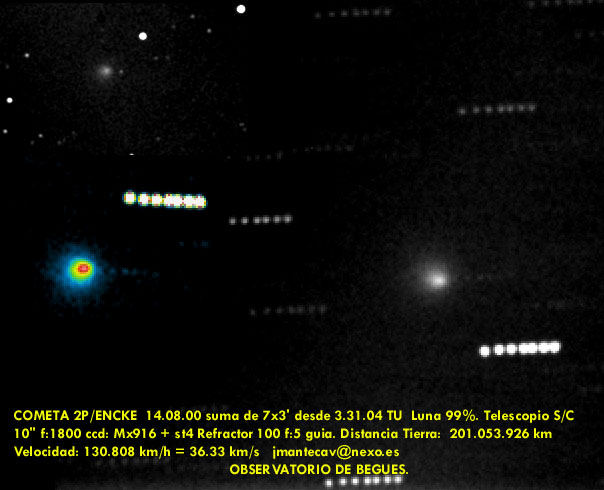
A few observers spotted the comet in early 2000 August, estimating it at around 11th mag. Pepe Manteca imaged the comet on August 10 and August 14. The comet was visible in the SOHO C3 coronagraph, but was fainter than expected and was only 8.8 on September 7.1. It suddenly brightened on September 14 around 15:00 to 6.5.
2003 The comet was picked up visually at the 2003 return in October, however it was initially very diffuse and significantly fainter than expected. In the Northumberland 0.30-m refractor x230 I estimated it 12.9 on October 24.89 with a 0.8', DC1 coma. It was half a magnitude brighter a couple of nights later. Following reports on the comet mailing list that it was significantly brighter in binoculars, I visited a dark sky site on October 27.94 and found it at 9.9 in 20x80B with a 4.5' DC3 coma. It was a very easy object in 25x100B. On November 16.81 I estimated it at 7.7 in 20x80B, with a 10' diameter DC2 coma. On November 26.73 it was 6.8 in 10x50B with a 13' DC3 coma. Many observers comment on the pronounced fan of material coming from a stellar nucleus. Most observers lost it in early December, but Juan Jos� Gonz�lez Su�rez was able to view it from a mountain location on December 24.28, estimating it as a stellar object of approx 4.7 in 25x1000B.
For the 2003 return 52 observations give a preliminary corrected light curve of 10.7 + 5 log d + 12.3 log r.
L. M. Woodney, University of Central Florida; and T. C. Owen and Y. R. Fernandez, University of Hawaii, report the detection of HCN from comet 2P/Encke. The HCN J(4-3) transition was observed during Nov 9-11 UT at the James Clerk Maxwell Telescope. The line had a FWHM of 1.4 km/s and an integrated line strength of 0.057 +/- 0.011 K km/s. Assuming a rotational temperature of 43 K, and using a Haser model, a production rate of Q(HCN) = 9.8 x 10**23 molecules/s was derived. [IAUC 8239, 2003 November 17]
F. Bensch, Harvard Smithsonian Center for Astrophysics (CfA); E. Bergin, University of Michigan; and G. Melnick, CfA, write: "We have monitored the 1(10)-1(01) emission of water vapor at 556.936 GHz toward comet 2P using the Submillimeter Wave Astronomy Satellite (SWAS). Between Nov. 7.04 and 15.21 UT, the line- integrated antenna temperature within the 3'.2 x 4'.5 elliptical SWAS beam varied between I < 0.252 (3-sigma upper limit for observations on Nov. 7.04-7.99) and I = 0.98 K km/s (Nov. 12.03- 12.99). The average line-integrated intensity for this period is I = 0.55 +/- 0.03 K km/s. The water-production rate, Q(H_2O), is derived using a spherical outflow model (Haser model) with a water photo-destruction rate of 1.366 x 10**-5 s**-1 and an assumed ortho-para ratio of 3. The uncertainty in the resulting Q(H_2O) is governed by the finite S/N ratio of the observations and the uncertainty in the electron abundance in the coma. (In addition to infrared fluorescence and H_2O-H_2O collisions, H_2O-electron collisions provide a significant contribution to the 1(10)-1(01) line excitation; our modeling of the electron abundance uses the same parameterization as Biver et al. 1999, A.J. 118, 1850). For observations made between Nov. 9.06 and 9.96 (I = 0.53 +/- 0.07 K km/s), we derive Q(H_2O) = (2.9 +/- 0.4) x 10**27 s**-1 for an electron abundance similar to those derived by in-situ measurements in the coma of 1P/Halley, and Q(H_2O) = (4.0 +/- 0.5) x 10**27 s**-1 for an electron abundance reduced by a factor of 0.2. Previous studies of this transition toward several other comets by SWAS and by the (sub)millimeter-wavelength satellite Odin have indicated that the electron density in cometary comae might be smaller by a factor of about 0.2, compared to the electron density in 1P/Halley (Biver, private communication, based on data from Lecacheux et al. 2003, A.Ap. 402, L55)." [IAUC 8249, 2003 December 4]
Observations in ICQ format, last observation 2003 December 24, updated 2003 December 29.
Comet 2P/Encke in 2007 2P/Encke put on a brief showing in the UK evening sky in late March and early April just before perihelion, when it was a binocular object in Pisces and Aries. After perihelion it was visible passing through the SOHO LASCO field and that of its successor, STEREO. STEREO imaged a disconnection event in the ion tail, and a NASA press release was issued in October.
This was comet Encke's 60th observed return to perihelion since its discovery by Mechain in 1786. This year the comet was briefly seen from the Northern Hemisphere prior to perihelion, with rather better views from the Southern Hemisphere after perihelion, when the comet is often brighter.
Martin Mobberley made an early image of the comet at its 2007 return, imaging it on 2006 December 9.81 when it was still only around 18th magnitude.
5 observations received give an uncorrected preliminary light curve of m = 10.7 + 5 log d + 8.3 log r
Observations in ICQ format, last observation 2007 April 13, updated 2007 April 16.
Comet 2P/Encke in 2010 This is comet 2P/Encke's 61st observed return to perihelion since its discovery by Mechain in 1786. The orbit is quite stable, and with a period of 3.3 years apparitions repeat on a 10-year cycle. This year it has a poor elongation prior to perihelion, but it will be visible passing through the SOHO LASCO field and that of its successors, the twin STEREO satellites in late July and early August. After perihelion the comet becomes visible from the Southern Hemisphere in mid August as a fading binocular object, and can be followed throughout September. BAA Members have been observing the comet for over 50 years and there is little evidence for a secular fading, although the comet is often brighter post perihelion than it is before. The comet is the progenitor of the Taurid meteor complex and may be associated with several Apollo asteroids.The comet was first picked up in the SOHO C3 field on August 4. It became visible to Southern Hemisphere observers mid-month.
34 observations received give an uncorrected preliminary light curve of m = 10.2 + 5 log d + 6.4 log r
Observations in ICQ format, last observation 2010 September 13, updated 2010 November 3.
126 observations received give an uncorrected preliminary light curve of m = 9.4 + 5 log d + 7.2 log r
Observations in ICQ format, last observation 2007 April 5, updated 2007 April 16.
The comet was recovered at its 2008 apparition in late April by observers at Lowell Observatory's Anderson Mesa Station and Kachina Observatory, Flagstaff. It was around 19th magnitude. It appears to have undergone something of an outburst around the time of perihelion
65 observations received so far at the 2008 return cannot be fitted into a normal light curve.
In 2002 it will be a morning object, becoming visible in February and reaching 11th magnitude in May after which it is unfavourably placed for observation from the UK. Observers at lower latitudes will be able to follow it until September. It moves eastwards, being in Aquarius in May.
Although few confirmed observations have been received, reports circulating on the internet suggest that the comet entered visual range in April. It is currently several magnitudes fainter than expected.
Observations in ICQ format, last observation 2002 August 13, updated 2002 November 6.
The comet was recovered in April 2007, with delta T of +0.13 days compared to the prediction on MPC 54167. Observations in early November suggested that it had reached 14th magnitude.
P. Jenniskens, Ames Research Center, supplied a prediction (Jenniskens and Lyytinen 2000, WGN, submitted) of enhanced activity in 2000 of the meteor stream associated with comet 8P/Tuttle. Notable Ursid outbursts near the time of 8P's aphelion occurred in 1945 and 1986. Maximum activity is anticipated around Dec. 22.31 UT from material ejected from the comet in 1405. Ejections in 1392 and 1378 could expand this activity over an interval of 4-5 hours. [IAUC 7455, 2000 December 18] P. Jenniskens, Ames Research Center, reports that preliminary results show that there was an enhancement of Ursid meteors visible between Dec. 22.2 and 22.4 UT, including several brighter than mag 1, with a peak (ZHR > 50) near the predicted time of Dec. 22.31 [IAUC 7548, 2000 December 23]
Observations by D. Schleicher, Lowell Observatory; and L. Woodney, California State University, San Bernardino, using CN narrowband imaging on Dec. 14 with the Hall 1.1-m telescope at Lowell Observatory show three radial arcs. If these are from the same jet, it implies a rotation period of 4.9 - 5.0 hours.
216 observations received give a preliminary light curve of m = 6.8 + 5 log d + 0.0429 abs(t-T-27.1)
Observations in ICQ format, last observation 2008 March, updated 2008 April.
I was finally able to observe the comet on 2005 April 4.9, finding it an easy object in the N'land refractor. It was mag 11.7, DC4 and diameter 0.7'. Observations in late May were putting it at around 10.5 - 11th magnitude.
Comet 9P/Tempel is the target for the Deep Impact mission and observations are requested.
Observations from the HST and the onboard Deep Impact camera show what appear to be minor outbursts of the comet during June. These are promoted as major events by the NASA Deep Impact site, although they are of short duration (dissipating in less than 12 hours) and are of small size (about 2000 km). Interestingly stars passing through the field appear to brighten during the event shown by the DI camera.
Following the impact, there was no obvious increase in visual magnitude, however the coma did become more condensed.
The Stardust-NExT spacecraft encountered 9P/Tempel at 03:40 UT on 2011 February 15. It returned images showing the effects of the Deep Impact hit on the comet in 2005 July.
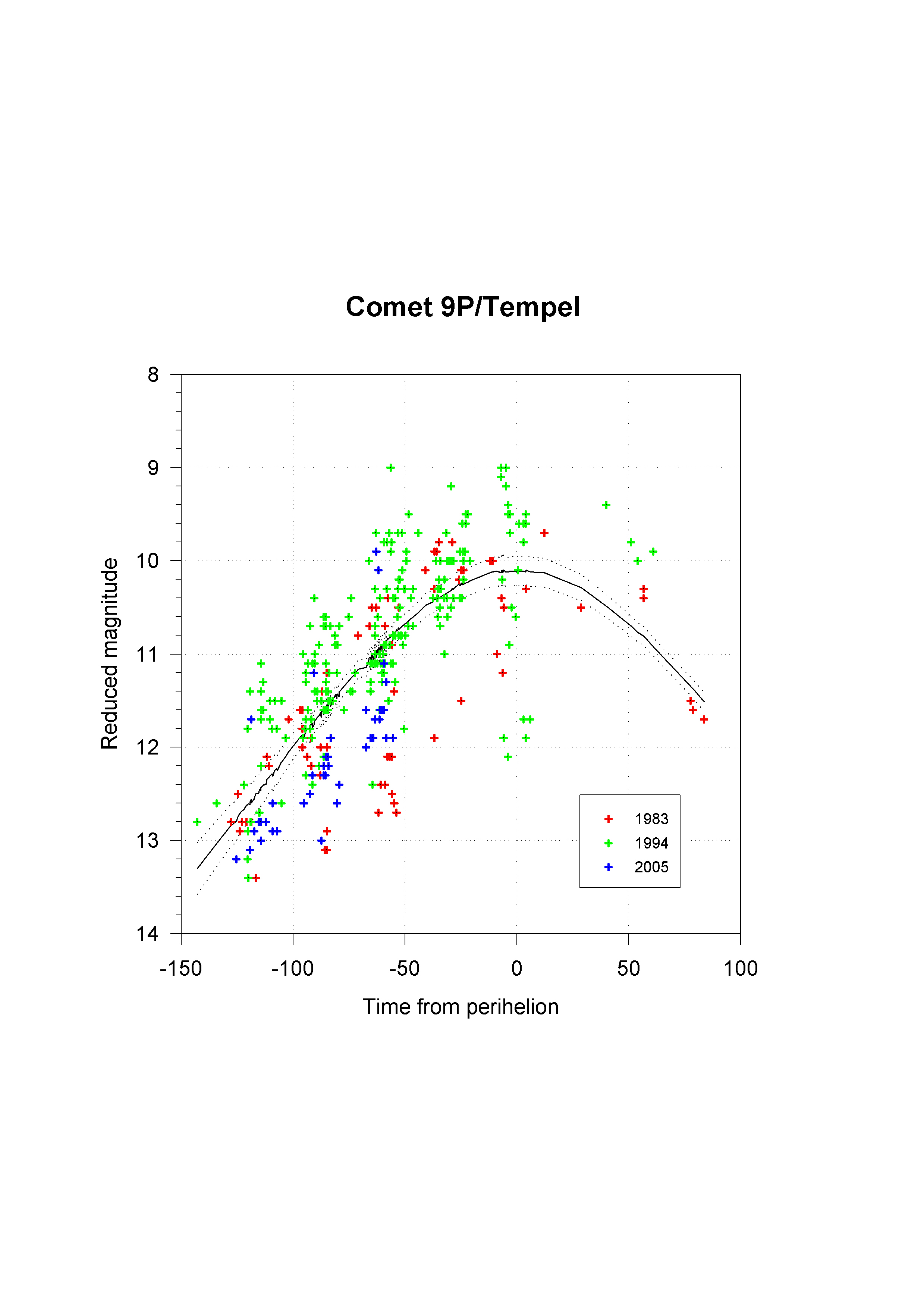
192 observations give a preliminary light curve of m = 6.8 + 5 log d + 23.1 log r. The H10 magnitude is 9.4. The light curve this year is very similar to those in 1983 and 1994 and taking all together gives an aperture corrected equation of m = 5.7 + 5 log d + 21.9 log r
Observations in ICQ format, 47 observations, updated 2005 June 1.
Traditionally the light curve is regarded as highly asymmetric with a late turn on. There is a rapid rise in brightness as perihelion approaches, which continues more slowly for a couple more weeks after perihelion, followed by a slow decline until activity switches off. An alternative view is that the light curve is linear with a peak about a month after perihelion.
With a 5.5 year period alternate returns are favourable and the 2010 return is one of them.
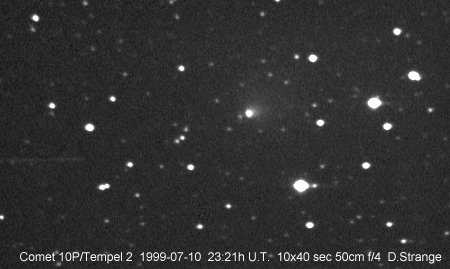
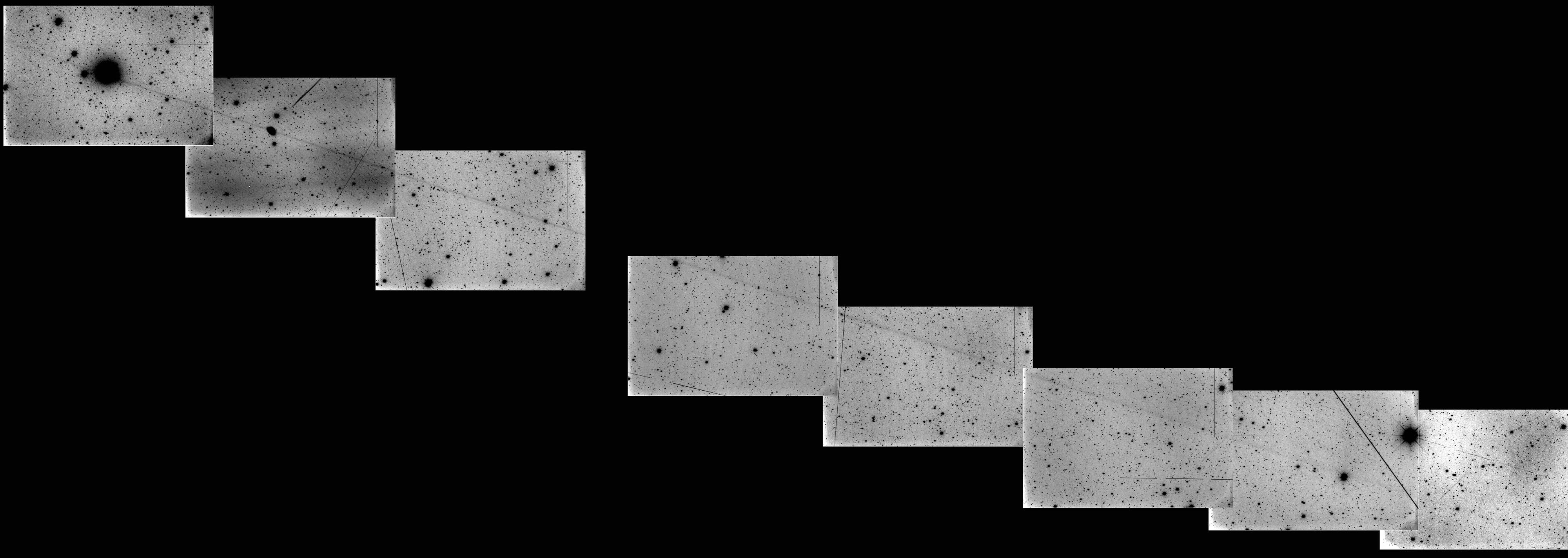
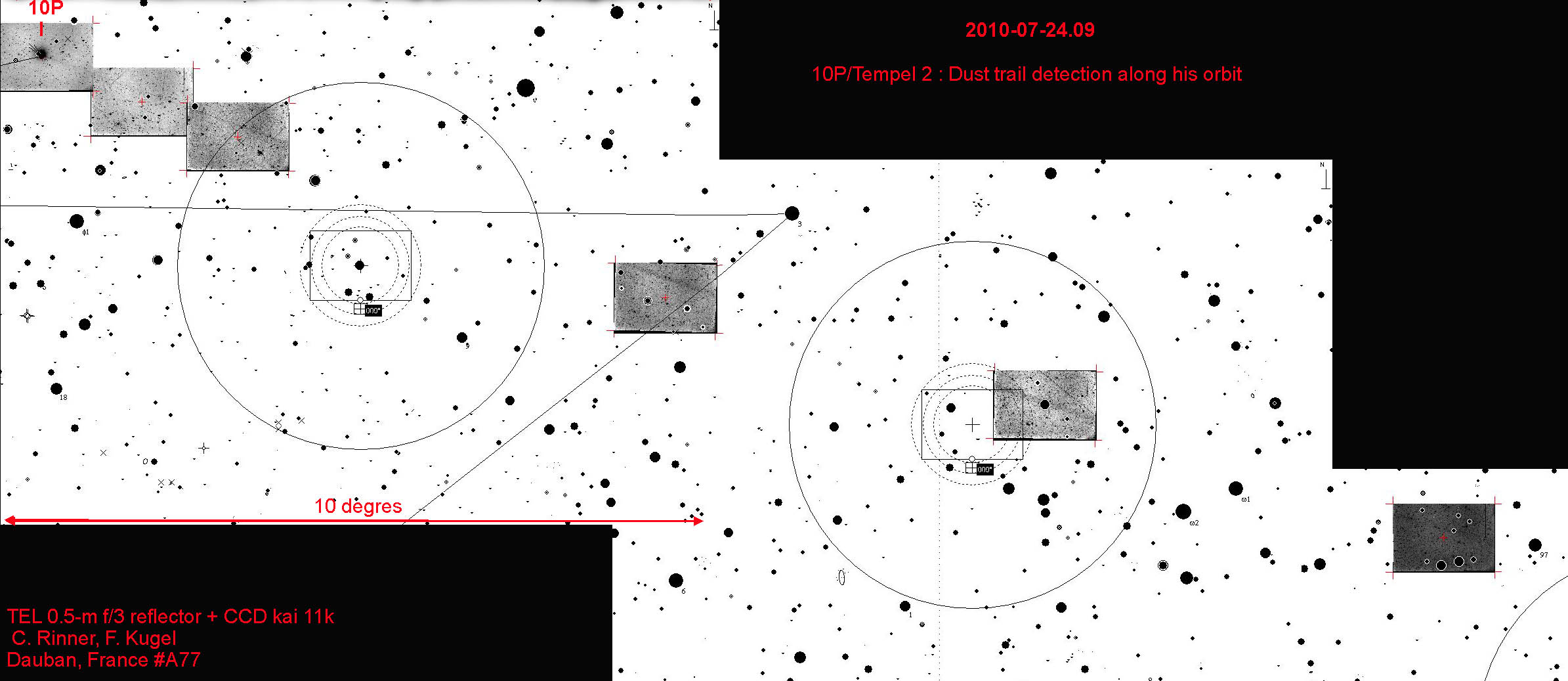
1999 David Strange obtained an image of the comet on July 10. Jose Carvajal estimated it at 10.6 in 32cm L on August 5.9, but I was unable to see it with 20cm R on the same night. On Aug 10.9 Andrew Pearce and I observed it with 14x100B from just outside Penzance, Cornwall, my estimate was 8.7 (HS) and Andrew made it a little fainter. Back in Cambridge it was a very difficult object in the 0.20-m refractor, though it was observed during the IWCA. Andrew Pearce now back in Australia reported that the comet has faded to near 10th mag at the end of August. It faded very slowly and it was still 12th mag in December. 2010 Deep images of 10P/Tempel showed a dust trail in the plane of the comet's orbit. Francois Kugel and C Rinner obtained a mosaic on July 14. Further images on July 24 show the trail extending over 20 degrees from the nucleus.
111 observations received at the 1999 return give an uncorrected preliminary light curve of m = 10.4 + 5 log d + 0.0295 abs(t-T-18.1) or 6.1 + 5 log d + 29.3 log r.
Observations in ICQ format , last observation 2000 January 30, updated 2000 August 16.
73 observations received at the 2010 return give an uncorrected preliminary light curve of m = 9.4 + 5 log d + 0.0152 abs(t-T-28)
Observations in ICQ format , last observation 2010 October 28, updated 2010 November 3.
4 observations received so far at the 2008 return suggest an uncorrected preliminary light curve of m = 8.7 + 5 log d + [15] log r
The comet was discovered by Edwin Holmes from London on 1892 November 6. He had been observing in poor conditions, and decided to have a look at the Andromeda galaxy with his 32cm reflector before stopping for the night. He found an unexpected object that wasn't M31. Other observers were initially skeptical, but the comet was soon confirmed. It remained bright for several weeks before slowly fading, and then underwent another outburst in mid January, which again brought it within naked eye range.
At its eight following returns the comet was a faint object. It was reported in outburst by Spanish amateurs on 2007 October 24, when near opposition, but well past perihelion. The brightest estimates so far suggest that it reached 2.5. It is fading very slowly, and by mid November was still 3rd magnitude, although it had expanded to 40' diameter.
Observations with the Super-WASP wide-field imaging system at La Palma captured the start of the comet's outburst, and show that it brightened from 9.7 to 8.6 over 2.6 at a rate consistent with the linear expansion of an optically thick coma. Extrapolating backwards in time suggests that the outburst commenced on October 23.8.
Richard Miles has produced an explanation for the outburst involving the catalytic decomposition of H2O2.
The comet was picked up by Michael Mattiazzo, who estimated it at 13th mag in mid June 2001. By July 22 it had brightened to 11.4, a bit fainter than expected. Observing on August 28.11 with my 0.20-m SCT x75 I made it 10.3, DC4, diameter 1.7'. It reached a peak of around 10th magnitude in September and then slowly faded. By late November it was around mag 11.5 and by early January around 12.5.
The spacecraft Deep Space 1 successfully imaged comet 19P/Borrelly on September 22.
D. Schleicher, Lowell Observatory, writes: ``I obtained narrowband photometry of comet 19P on Sept. 18 and 19 using the Hall 1.1-m telescope at Lowell Observatory, yielding the following averaged production-rate results: log Q(OH) = 28.34; equivalent log Q(water; vectorial) = 28.41; log Af(rho) = 2.50 (cf. IAUC 7342). The radial fall-off of the dust is significantly steeper than the canonical 1/(rho), with Af(rho) decreasing by 1.9 times between rho = 20 000 and 110 000 km." [IAUC 7722, 2001 September 21]
Visual m_1 estimates: Sept. 1.11 UT, 10.0 (R. J. Bouma, Groningen, The Netherlands, 0.25-m reflector); 28.14, 9.9 (W. Hasubick, Buchloe, Germany, 25x100 binoculars); Oct. 11.08, 10.1 (B. H. Granslo, Fjellhamar, Norway, 0.20-m reflector); 18.68, 10.3 (Y. Nagai, Yamanashi, Japan, 0.32-m reflector); 24.96, 10.7 (V. S. Nevski, Vitebsk, Belarus, 0.30-m reflector). [IAUC 7739, 2001 October 25]
In 2009 Bernhard Haeusler imaged the comet between March 20 and June 12, detecting a sunward pointing tail, with a condensation possibly coming from jets active on the opposite pole to those seen by DS1.
120 observations received give an uncorrected preliminary light curve of m = 6.8 + 5 log d + 18.4 log r
Observations in ICQ format, last observation 2002 May 18, updated 2002 September 29.
Comet 21P/Giacobini-Zinner is the parent comet of the October Draconid meteors. On this occasion we pass just inside the comet's orbit 92 days after the comet, with any shower taking place on October 8.7.
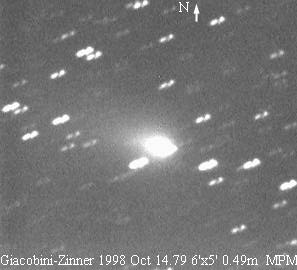
The comet was first discovered by Michael Giacobini at Nice observatory in December 1900 and was thought to have a period of 6.8 years. The next two returns were expected to be difficult to observe, but in October 1913, Ernst Zinner, of Bamberg, Germany, discovered a comet whilst observing variable stars in Scutum. This turned out to be the same comet, but the period had been incorrectly determined. The comet was missed at three unfavourable returns, so the 1998 return was the thirteenth apparition of the comet. It will come within visual range in 2005 March, but is not well placed for the UK until April, when it may be 12th magnitude. It is a morning object, and draws back into the Sun, so that we will lose it again in 2005 May, by which time it may have brightened to 10th magnitude. For most of this period it is in Pegasus.
Martin Mobberley imaged the comet on 1998 October 14 and October 25 .
In 1998 223 observations received gave an uncorrected preliminary
light curve of
8.9 + 5 log d + 13.6 log r
In 2005 22 observations give an uncorrected preliminary lightcurve of
8.5 + 5 log d + 19.9 log r
Observations in ICQ format , last observation 1999 April 29, updated 1999 July 7.
22P/Kopff was discovered photographically by A Kopff at Konigstuhl Observatory in 1906, when it was around 11m. The next return was unfavourable, but it has been seen at every return since then. Following an encounter with Jupiter in 1942/43 its period was reduced and the perihelion distance decreased to 1.5 AU. The following return was one of its best and it reached 8m. The next return was unusual, in that it was 3m fainter than predicted until perihelion, when it brightened by 2m. It suffered another encounter with Jupiter in 1954, but this made significant changes only to the angular elements. 1964 was another good return and the comet reached 9m.
The 2002 return was not favourable and only a few observations were received. Although now near its brightest it is poorly placed.
An analysis of the data from 1996 gave a light curve of 7.5 + 5 log d + 10 log r, but this was very indeterminate. The 2009 data (62 observations) suggest 8.3 + 5 log d + 8.9 log r
1996 Observations in ICQ format reported to 1997 October 30.
2002 Observations in ICQ format reported to 2002 November 6, last observation 2002 September 29.
Comet 24P/Schaumasse Alexandre Schaumasse discovered comet 24P/Schaumasse during a visual search with the 400mm coude equatorial at Nice, France in 1911 December as a 12m diffuse object and it reaches a similar magnitude at average returns. The 1952 return was very favourable and the comet reached 5m, though there may have been an outburst. The orbit is relatively stable and this will be its 10th observed return. UK observers may pick up the 13m comet in the evening sky in February as it brightens on its way to perihelion. Moving northwards in Aries, it passes into Taurus in mid March when it should be a magnitude brighter. It is at its brightest tracking through Auriga at the end of April and early May when it should be at nearly 10m. Passing into Gemini we will loose it low in the summer twilight by the end of the month.
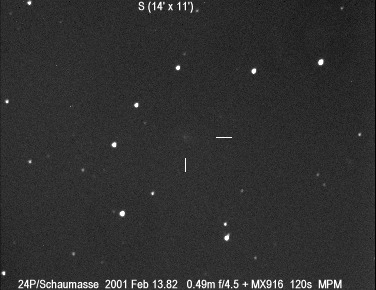
Martin Mobberley imaged the comet on February 13 and estimates the CCD magnitude as around 15 - 16. I observed on February 14.8 with the Northumberland refractor and immediately saw a diffuse object in the expected position, which I estimated at 13.6. This is rather brighter than the CCD magnitude and will need further confirmation. A further observation on March 12.8 put the comet at 13.2. I was able to glimpse it in the Thorrowgood refractor on April 24, estimating it at around 11.9.
78 observations received give an preliminary light curve of 7.7 + 5 log d + 29.2 log r
Observations in ICQ format reported to 2002 June 26, last observation 2001 June 20.
Comet 26P/Grigg-Skjellerup On 2008 June 12 NASA resulted a news bulletin announcing the discovery of a new mineral in dust particles captured in the Earth's atmosphere, which were possibly from 26P.
Comet 27P/Crommelin 27P/Crommelin has a poor return ijn 2011 and will not be visible from the UK. Its maximum elongation whilst brighter than 14th magnitude is only 37�, and it is then at a northern declination. The comet is named for the BAA Comet Section Director, A C Crommelin, who first computed a linked orbit for comets seen in 1818, 1873 and 1928. It was quite well observed in 1984 when it served as a test comet for the International Halley Watch.
A few observations were made in early July 2011 when the comet was around 10th magnitude.
Comet 29P/Schwassmann-Wachmann 1997 In February and early March 1997 the comet was in outburst, peaking at around 12th mag. It was not seen in April, but returned to visibility in early May, rising to 12th mag late in the month. I observed it at 13.7: on May 12.95 with the Northumberland 0.30-m refractor. On May 29.97 it was 12.0: in my 0.20-m T x 75, dia 1.8', DC3. Andrew Pearce reports glimpsing it at around 14th mag in his 0.41-m reflector at the end of December 1997.
1998 Further reports suggest that the comet brightened to around 12th mag visually and then faded to 14th mag. Another outburst commenced in mid March 1998 according to IAUC 6844 and the comet is now around 13th mag, though I was unable to see it on April 28.9, when it was fainter than 13.2. It may be undergoing another outburst at around 13th mag (May 30).
1999 Andrew Pearce discovered it in outburst on 1999 March 31. It was well condensed and so relatively easy to see, but faded below 14th mag. Reports suggest another outburst to around 13th magnitude in early June. Jose Aguiar reported it in outburst once again at the beginning of July.2000 Jose Aguiar reported as possibly being in outburst on July 1
2001 The comet is undergoing another outburst, as shown by the following total magnitudes (CCD unless otherwise indicated): Apr. 22.80 UT, 15.5 (A. Nakamura, Kuma, Ehime, Japan, 0.60-m reflector); 28.44, 15.7 (A. Hale, Cloudcroft, NM, 0.2-m reflector); May 17.69, 13.2 (K. Kadota, Ageo, Saitama, Japan, 0.18-m reflector); 18.71, 13.4 (Kadota); 19.73, 12.0 (K. Yoshimoto, Hirao, Yamaguchi, Japan, 0.25-m reflector; visual); 27.77, 13.5 (Nakamura). [IAUC 7640, 2001 June 1] Further outbursts have taken place and the comet remains at around 12th magnitude into August.
2002 This comet appears again to be in outburst, as indicated by the following total-magnitude estimates (visual unless otherwise noted): Mar. 20.83 UT, [16: (T. Kojima, Chiyoda, Japan, 0.25-m reflector + CCD); 27.80, 14.4 (Kojima); May 8.46, 13.5 (A. Hale, Cloudcroft, NM, 0.41-m reflector); 9.46, 13.3 (Hale); 21.45, 13.3 (Hale); June 8.39, 12.3 (Hale; near-stellar appearance); 9.75, 12.0 (A. Nakamura, Kuma, Ehime, Japan, 0.60-m reflector + CCD; strong condensation). [IAUC 7918, 2002 June 13]
Carlos Labordena (Spain) reported the comet in outburst on November 1, at 12th magnitude with a well condensed coma. Michael Mattiazzo (Australia) also reported the comet bright, with the comet at around 14th magnitude through most of October, brightening at the end of the month. The degree of condensation was quite variable suggesting a series of outbursts, with perhaps one around October 27 and another around November 4.
2003 Salvador Sanchez, Jaime Nomen and Reiner Stoss observed the comet on the morning of May 22 with the remotely controlled 30-cm telescope of the Observatorio Astronomico de Mallorca. The comet looked to be in outburst. The measured magnitude was 13.5 N on 80s CCD frames at an SNR of 30. Juan Jose Gonzalez reported the comet at 13.1 on July 23.02. A further outburst was reported at the end of September.
2004
Seichi Yoshida notes the following pattern of activity:
The high level activities in 2002 and 2004, and the low level activity in 2000 are remarkable.1997 Two outbursts occured, but faint in general. 1998 After outburst in late January, it kept bright for a while though diffused. Only one outburst. Not visible visually in the latter half. 1999 Not visible visually in the former half. After outburst in late March, it kept bright for a while though diffused. Only one outburst. 2000 No outburst. Not visible visually almost at all. 2001 Major outburst occured in August. Some other small outbursts occured, too. Every outburst was short, and it became invisible soon. 2002 Outbursts often occured. It was brighter than 13 mag in many times. It became so faint temporarily in July. 2003 Outbursts often occured, but small, and only 13 mag at best. 2004 Outbursts frequently occured. It kept bright around 12 mag all through the year.
2005 The comet was reported in outburst in July. A second outburst was reported in mid August. Another outburst began in mid September and I estimated it at 12.1 and DC6 in the N'land refractor x185 on September 18.96 There was another outburst in mid December and it was an easy object in the N'land refractor on December 17.9
2006
The comet was reported in outburst at around 13th magnitude in mid July 2006. An image taken by Martin Mobberley on December 16.8 showed the comet at around 12th magnitude.
2007 It spent the first quarter of the year in Taurus before sinking into solar conjunction. It emerged into the morning sky of Auriga in August, reaching opposition there at the end of the year. Generally outbursts seem not to have been so frequent in 2007, however it was reported in outburst at 13th magnitude in late December.
2008
It spent the first third of the year in Auriga before sinking into solar conjunction. It emerged into the morning sky of Gemini in August, and spent the last third of the year in Cancer. Unusually there was no opposition in 2008. A major outburst occurred in January and it reached 11th magnitude mid-month. A further outburst occurred in mid September, when it again reached 11th magnitude. It seems to have spent most of this year within visual range. Another outburst commenced around December 18.
Comet 29P/Schwassmann-Wachmann in 2009
This annual comet has frequent outbursts and over the past few years seems to be more often active than not, though it rarely gets brighter than 12m. It is possible that its pattern of behaviour is changing. In early 1996 it was in outburst for several months. In the first half of 1998 it was in outburst on several occasions and this also occurred in 1999. The randomly spaced outbursts may be due to a thermal heat wave propagating into the nucleus and triggering sublimation of CO inside the comet. This comet is an ideal target for those equipped with CCDs and it should be observed at every opportunity.
The comet begins the year retrograding in Cancer and passes into Gemini around the time of opposition on January 17. It resumes direct motion around the time of the northern spring equinox and will be lost to UK observers in early May. It is in solar conjunction on August 1. For UK observers it will become observable in the morning sky in October, by which time it is in Leo.
Richard Miles notes that it was at opposition on January 17, when it had a phase angle of only 0.5 degrees and this may have lead to an opposition effect brightening. Some jet structure was observed in the coma around this time, and he further notes that it will be important to follow their evolution as the comet is reported to be a slow rotator (about 60 days).
2010 The comet underwent a major outburst in February, reaching 10th magnitude. This was around the time of opposition, when the phase angle was 0.3 degrees.
Comet 29P/Schwassmann-Wachmann in 2011 29P/Schwassmann-Wachmann underwent a minor outburst at the end of February reaching 12th magnitude. Another outburst took place in late March, with the comet again reaching 12th magnitude.
36 observations received in 2004 give a preliminary light curve of 6.9 + 5 log d + 16.7 log r
Observations in ICQ format, last observation 2005 May 4, updated 2005 May 11.
49 observations received in 1999 give an uncorrected preliminary light curve of 10.6 + 5 log d + 11.8 log r
Observations in ICQ format , last observation 1999 October 10, updated 1999 October 31.
At the 1973 return, which was similar to the 1907 return, it underwent a major outburst and reached 4m, before fading and then undergoing a second outburst. Alternate returns are unfavourable but the comet has been observed at a few of them.
The comet appears to be in outburst, as indicated by the following visual m_1 estimates: 2000 Nov. 27.53 UT, 10.2: (A. Hale, Cloudcroft, NM, 0.41-m reflector); 28.83, 10.5 (Y. Nagai, Yamanashi, Japan, 0.32-m reflector); Dec. 1.82, 10.4 (M. Tsumura, Wakayama, Japan, 0.32-m reflector). [IAUC 7536, 2000 December 5]
The comet appears to be continuing its rapid brightening (cf. IAUC 7536), as indicated by the following m_1 estimates: Dec. 5.82 UT, 11.1 (S. Yoshida, Ibaraki, Japan, 0.25-m reflector; visual); 6.52, 11.4 (A. Hale, Cloudcroft, New Mexico, 0.41-m reflector; visual); 15.83, 8.7 (K. Kadota, Ageo, Saitama, Japan, 0.18-m reflector + CCD; 3' coma and 16' tail). [IAUC 7543, 2000 December 15]
28 observations received give a preliminary light curve for the outburst of 6.1 + 5 log d + 0.117 * abs(t - T - 18.5)
Observations in ICQ format , last observation 2001 January 18, updated 2001 June 23.
Comet 43P/Wolf-Harrington is at its brightest (12th mag) at the beginning of the year, and slowly fades as its elongation in the evening sky decreases. It is favourably placed and CCD observers should certainly have a go at following the comet. This will be the tenth observed return of the comet, which was discovered in 1924, then lost until 1951. The comet is in a chaotic orbit, and made a close approach to Jupiter in 1936 which reduced its perihelion distance from 2.4 to 1.6 AU. It made an exceptionally close (0.003 AU) approach to Jupiter in 1841, which switched its previous perihelion distance into the new aphelion distance.
I observed it on 1997 September 9.14 in my 0.20-m SC, making it 13.4:, dia 0.9' and DC2. On October 10.17 it was a weakly condensed diffuse glow in the 0.30-m refractor x170, DC2, diameter 1.0'. On November 4.2 it was 12.6 in the 0.30-m refractor.
Observations in 1997 gave an uncorrected
preliminary light curve of
9.3 + 5 log d + 12.9 log r
Observations in ICQ format, last observation 1998 January 31, updated 1998 February 4 .
Observations in ICQ format, last observation 2003 December 20, updated 2003 December 29.
Observations in ICQ format, last observation 2002 February 24, updated 2002 April 2 .
Comet 45P/Honda-Mrkos-Pajdusakova
2001
makes its 10th observed return since discovery in 1948 (it was missed in 1959). It has had several close encounters with Jupiter, the most recent in 1983 which made dramatic changes to w and W . The perihelion distance has steadily decreased and is now the smallest it has been for the last 200 years. It can approach quite closely to the Earth and will do so in 2011 (0.06 AU) and 2017 (0.08 AU). At present the MPC only lists eight approaches closer than 0.06 AU, and five of these are by periodic comets. It was well observed at its last return in 1995/96. The comet will be in the field of the SOHO LASCO coronagraphs in March, though it may be too faint to be seen. Observers at low northern latitudes should be able to observe it as it recedes from the sun during April and early May.On 2001 Apr. 4.42 UT, K. Kadota, Ageo, Saitama, Japan, reports m_1 = 10.5 and coma diameter 0'.8 (0.18-m reflector + CCD). An ephemeris for 45P appears on MPC 42593 (orbital elements on MPC 42548). [IAUC 7608, 2001 April 9]
Gabriel Oksa reports a visual observation on 2001 April 17.8, when he estimated the comet at 9.3 in a 0.15m R x60, coma 2.5' diameter, DC4.
22 observations received give a
preliminary light curve of
11.0 + 5 log d + 11.1 log r
Observations in ICQ format, last observation 2001 May 19, updated 2001 June 25 .
2011
This year there is an excellent return of 45P/Honda-Mrkos-Pajdusakova. Southern Hemisphere observers are likely to pick it up near opposition in July, when it is a 12th magnitude object in Pisces Austrinus. It heads even further south, brightening rapidly as it passes only 0.06 AU from the Earth on August 16, when it might be seen with the naked eye. It passes through conjunction at the end of the month and fades a little, but brightens again as it approaches perihelion at the end of September. UK observers had a chance to see it between mid September and mid October, although it was quite low in the morning sky.32 observations received give a
preliminary light curve of
13.2 + 5 log d + 21.1 log r
Carl A Wirtanen discovered 46P/Wirtanen at Lick in 1948. It is in a chaotic orbit, and its perihelion distance was much reduced due to approaches to Jupiter in 1972 and 84. It has been reported to outburst, but BAA data suggests that it has just been rejuvenated after the perihelion distance was reduced. A December perihelion would give a close approach to the Earth, and as the present period is now less than 5.5 years this will be achieved in 2018, when the comet could reach 3rd magnitude. It is a target for the Rosetta mission.
It peaked at around 10th mag in 1997 March.
Observations in ICQ format, last observation 1997 May 31, updated 1997 July 28
The comet was a morning object in 2002. The first visual observation was reported in early August when the comet was around mag 11.5. Observations suggest that the comet peaked at around 9th magnitude in late September. I observed it on October 19.18, estimating it at 10.4 in my 20cm LX200 x75. The observations are currently best fitted by a linear type light curve, with the comet brightest about a month after perihelion.
Observations received (26) give a preliminary light curve of 7.7 + 5 log d + 0.0427*(t-T+30.4)
Observations in ICQ format, last observation 2002 November 17, updated 2003 January 22007/8 This is a relatively good return with the comet reaching 9th magnitude in the evening sky around the time of its February perihelion. The comet travels eastwards, not that far from the ecliptic, crossing to northern declinations in late January and crossing north of the ecliptic in early February. It should be possible to continue observations until May as it fades.
67 observations received give an uncorrected preliminary light curve of m = 8.5 + 5 log d + 20.5 log r.
Michael Mattiazzo recovered the comet at 14.0 on 2000 July 4.
7 observations received give an uncorrected preliminary light curve of m = 2.1 + 5 log d + 25.9 log r.
Observations in ICQ format , last observation 2000 August 28, updated 2000 August 30.
Observations in ICQ format, last observation 1999 November 30, updated 2000 February 25.
Comet 51P/Harrington was P. Manteca, Observatorio de Begues (near Barcelona), reports that his observations on Dec. 6.1 UT (0.31-m f/6.3 Schmidt- Cassegrain reflector + CCD) showed this comet to have split, the two components being separated by some 10" on an east-west line. Each around mag 17.0-17.4, the western component was perhaps up to 0.4 mag brighter than the eastern, which is evidently the one that was under observation during July-November. On Dec. 7.0 and 7.9 Manteca gave m_1 = 16.4 for the eastern component and m_1 = 16.6 for the western. The eastern component is also clearly the object defined as component A at the comet's 1994 apparition, when two much fainter components, B and C, were also recorded with an effective perihelion time almost 0.3 day later (cf. IAUC 6089). The current western component is therefore to be denoted as component D, and its effective perhelion time on 2001 June 5 is only about 0.006 day later than that of component A. The splitting was confirmed by R. Naves and M. Campas (Observatorio Montcabre, also near Barcelona; 0.25-m f/3.3 Schmidt-Cassegrain reflector + CCD), who gave m_1 as 16.9 for component A and 16.7 for component D on Dec. 6.9 and 16.2 for component A and 16.3 for component D on Dec. 7.9. R. Ferrando (Observatorio Pla D'Arguines, near Valencia; 0.30-m Schmidt-Cassegrain reflector + CCD) gave m_1 as 16.5 for component A and 16.7 for component D on Dec. 7.9. The comet is noticeably brighter than the predicted magnitude given in the ephemeris on MPC 43692. [IAUC 7769, 2001 December 8]
Z. Sekanina, Jet Propulsion Laboratory, writes: "Preliminary analysis of the reported astrometric data for the two nuclei (IAUC 7769, MPEC 2001-X45) indicates that companion D separated from primary A on Sept. 5.6 +/- 3.6 TT, or 3 months after perihelion, with a relative deceleration of 59 +/- 8 units of 10**-5 the solar attraction. The two separation parameters are, however, highly correlated and probably more uncertain than their formal errors suggest. Unless too faint, the companion should have shown up in high-resolution images taken since mid-October, when it was about 4" to the west of the primary. Predicted separation distances and position angles (0h TT): 2001 Dec. 17, 12", 268 deg; 2002 Jan. 6, 10", 263 deg; Jan. 26, 9", 255 deg; Feb. 15, 9", 249 deg; Mar. 7, 11", 248 deg; Mar. 27, 15", 251 deg; Apr. 16, 19", 255 deg; May 6, 24", 259 deg." K. Kadota, Ageo, Saitama, Japan, reported CCD observations that indicated an intrinsic brightening of more than two magnitudes between Aug. 22 and Sept. 23 (an outburst confirmed by other observers). [IAUC 7773, 2001 December 13]
The comet was recovered on 2008 July 28.43 by the Catalina Sky Survey, with delta T of 0.98d. Further observations were made in October 2008, when the comet was around 17th magnitude.
Observations in ICQ format, last observation 2001 December 12, updated 2001 December 19.
Comet 52P/Harrington-Abel was found in outburst at 12th mag by Alain Maury, Observatoire de la Cote d'Azur, on CCD images taken on July 21.1 UT when its predicted magnitude was about 21. [IAUC 6975, 1998 July 25]. A second outburst may have occured some 80 days before perihelion.
The comet reached perihelion and opposition in late January 1999. This is the seventh observed return of the comet since its discovery in 1954 and it has never became brighter than 17th magnitude at previous returns. Normally it would not be expected to get brighter than 15th magnitude at this return, however it was found in outburst at 12th magnitude in July 1998 and was 7 magnitudes brighter than expected. I glimpsed it a few times in mid March with the Northumberland, making it around 13th mag. Observing on April 9/10 with the Northumberland I could not see the comet, estimating it fainter than 13.8. NGC 2455 which lay nearby was clearly visible and estimated at 13.1 compared with the catalogued magnitude of 13.2.
Observations received so far (34) give an uncorrected preliminary light curve following the second outburst of m = 10.2 + 5 log d + 0.0416abs(t-T+23.1).
Observations in ICQ format, last observation 1999 April 29, updated 1999 August 12.
Comet 53P/van Biesbroeck 53P/van Biesbroeck is an interesting object. George van Biesbroeck discovered it at Yerkes observatory in September 1954. Stan Milbourn and George Lea calculated the best recovery orbit and the comet was duly recovered in May 1965. Back calculating the orbit shows that it made a moderately close approach to Jupiter in 1850, which reduced q from 2.7 to 2.4 AU and reversed the nodes. The pre 1850 orbit is very similar to that of 42P/Neujmin 3 and it is likely that they are fragments of the same parent. The comet has a relatively favourable return and just reaches 14th magnitude, however it lies south of the equator and will be difficult to observe from the UK.
Observations in ICQ format, last observation 2003 July 26, updated 2003 December 9.
Comet 54P/de Vico-Swift-NEAT K. Lawrence, S. Pravdo, and E. Helin, Jet Propulsion Laboratory, report the discovery on Oct. 11.22 UT of a 19.3 mag comet (with a nuclear condensation of diameter about 4" and a tail about 20" long toward the south-southwest) on NEAT images taken at Palomar. M. Hicks reports that images taken by J. Young at Table Mountain on Oct. 12.3 (through cirrus clouds) show a diffuse coma and a faint 5" tail to the southwest. D. Balam, University of Victoria, reports that images taken by J. Clem with the 1.82-m Plaskett telescope (also on Oct. 12.3) also show the object to be cometary in appearance (3 pixels, or 3".3, larger than nearby stars). [IAUC 7991, 2002 October 12]
The comet was named 2002 T4 (P/NEAT), but it was quickly realised that this was not a new comet:
A. Nakamura, Kuma, Ehime, Japan, reports that K. Muraoka (Kochi, Japan) has identified comet P/2002 T4 (cf. IAUC 7991) with 54P, last seen in 1965. The indicated correction to the prediction on MPC 34423 (ephemeris on MPC 46016) is Delta(T) = -7.5 days. Calculations by B. G. Marsden, Smithsonian Astrophysical Observatory, indicate that the comet passed 0.16 AU from Jupiter on 1968 Oct. 18.[IAUC 7992, 2002 October 13]
At its 2009 return it was recovered by David Herald at Kambah, and by C. Rinner and Francois Kugel at Observatoire Chante-Perdrix, Dauban. in mid August at around 19th magnitude. This is the first time the comet has been observed at successive apparitions (previous returns were 1844, 1894, 1965 and 2002).
Observations in ICQ format, last observation 2004 October 12, updated 2004 October 19.
Comet 57P/du Toit-Neujmin-Delporte is too faint for observation.
It was observed in outburst at the 1996 return and in July 2002 NEAT discovered a secondary component. A further 18 components were discovered by Fernandez et al at the University of Hawaii.A faint object reported as a possible NEO candidate on July 12.21 by S. Pravdo, Jet Propulsion Laboratory, on behalf of NEAT and described as appearing cometary was recognized at the Minor Planet Center as being on the line of variation and to have the motion of comet 57P, but to be displaced from that brighter comet (which was not included in the dataset) by more than 0.2 deg on the 1.2-m Palomar Schmidt frames. NEAT had reported the brighter comet on July 1 (see MPEC 2002-N14), but a check with Pravdo yesterday did not reveal anything obvious at the July 1 expected position of the new object. Following a request by the Minor Planet Center, M. Tichy and J. Ticha (Klet, KLENOT 1.06-m reflector) located the new object last night, describing it as diffuse and having a coma of diameter 8"-10"; as did G. Masi and F. Mallia (Campo Catino, 0.8-m f/8 reflector), whose coaddition of five images (for a total integration of 20 min) showed a well-defined 12" coma and a delicate northeast-southwest elongation. The object was again included in today's NEAT NEO-candidate report but with no remark about its appearance.
The positions are fully consistent with the orbital elements for comet 57P on MPC 45964 (ephemeris on MPC 44939) with T for this "component B" delayed by 0.19 day (i.e., to 2002 July 31.37 TT). It should be noted that comet 57P was anomalously bright at its unfavorable 1996 return (T = 1996 Mar. 5.7; m1 = 13.3 at the first postperihelic observation on July 24.8--see MPC 27482--some 5 mag brighter than expected). [IAUC 7934, 2002 July 13]
Y. R. Fernandez, D. C. Jewitt, and S. S. Sheppard, University of Hawaii, report the detection of an additional 18 components (C-T) of comet 57P (cf. IAUC 7934) in observations taken on July 17.5 and 18.4 UT with the University of Hawaii 2.2-m reflector. R-band magnitudes range from 20.0 to 23.5. The components range from well condensed to diffuse with little central condensation and have comae of diameter 1"-5". Components I, K, L, N, P, and T show a lack of central condensation. The components are delayed with respect to T = 2002 July 31.181 TT for component A by the following times (in days): C, +0.012; D, +0.037; E, +0.053; F, +0.078; G, +0.156; H, +0.164; I, +0.170; J, +0.180; (B, +0.188); K, +0.194; L, +0.194; M, +0.224; N, +0.226; O, +0.240; P, +0.271; Q, +0.309; R, +0.311; S, +0.313; and T, +0.354. [IAUC 7935, 2002 July 20]
Total magnitude estimates for the primary component (visual unless otherwise noted): June 5.71 UT, 15.6: (A. Nakamura, Kuma, Ehime, Japan, 0.60-m reflector + CCD); 9.68, 15.4 (Nakamura); 18.70, 15.7 (K. Kadota, Ageo, Saitama, Japan, 0.18-m reflector + CCD); July 5.27, 13.4 (A. Hale, Cloudcroft, NM, 0.41-m reflector); 10.24, 13.3 (Hale); 10.95, 14.1 (K. Sarneczky, Agasvar, Hungary, 0.38-m reflector); 11.59, 14.5 (Y. Ezaki , Toyonaka, Osaka, Japan, 0.30-m reflector + CCD). [IAUC 7937, 2002 July 24]
Z. Sekanina, Jet Propulsion Laboratory, writes: "Very preliminary analysis of the relative astrometry of the two brightest nuclei (cf. MPEC 2002-O10) has been completed, employing a new computer code recently developed by P. W. Chodas and myself. The parameters of the standard model for split comets are now determined with full account of the planetary perturbations and the nongravitational effects on the principal nucleus. The results suggest that nucleus B could have broken off from primary A near perihelion in 1996. If the event had occurred exactly at perihelion, plausible values for the nongravitational deceleration (4-8x10^-5 solar attraction, as B is obviously a persistent companion; cf. Sekanina 1982, Comets, ed. L. L. Wilkening, pp. 251-287) require that B separated from A with a reasonably low velocity, whose transverse component ranged from 0.5 to 1 m/s in the direction opposite the orbital motion and whose normal component was some 0.4-0.5 m/s toward the north orbital pole. These solutions are independent of the radial component of the separation velocity. Similar solutions are also found for separation times 100 days before and after perihelion, except that the deceleration then correlates with both the transverse and radial components. Because of the comet's extremely low orbital inclination, it is doubtful that the separation parameters can ever be determined with high accuracy. All examined solutions yield essentially the same ephemeris, which shows that the projected separation of B from A will diminish in the coming weeks. The offsets and position angles are as follows (0h UT): 2002 Aug. 4, 853", 259.1 deg; 14, 814", 259.1; 24, 758", 259.0; Sept. 3, 694", 258.7; 13, 631", 258.3; 23, 571", 257.7; Oct. 3, 516", 257.0. It is unlikely that companions C-T (cf. IAUC 7935) are all products of the same event. In particular, C-F were probably released from A more recently than B was. Some of nuclei M-T may be fragments of B, but a more complex fragmentation hierarchy is also possible. Accurate astrometry on existing images and additional observations may allow one to make more, but not very, definite statements in the future.'' [IAUC 7946, 2002 August 3]
Further to his report on IAUC 7946, Z. Sekanina writes: "Using the code developed by P. W. Chodas and myself, I was able to link the observations of the Aug. 7 secondary nucleus (MPEC 2002-P75) with those of companion F on July 17 (MPEC 2002-P30). An excellent fit (mean residual 0".26) suggests that F separated from nucleus A most probably in the second half of May 2001, a little more than 400 days before perihelion at a heliocentric distance of about 3.6 AU. By contrast, all attempts to fit the offsets on the assumption of a separation near the 1996 perihelion have failed, leaving systematic residuals of a few arcsec. The 2001 solution is rather insensitive to the adopted nongravitational deceleration, if it is on the order of several units of 10**-4 solar attraction. The derived separation velocity is then about 5 m/s, mostly in the orbital plane. The predicted separation distances and position angles (0h TT): 2002 Aug. 14, 401", 259.0 deg; 24, 398", 259.0 deg; Sept. 3, 393", 259.0 deg; 13, 387", 258.8 deg; 23, 383", 258.4 deg; Oct. 3, 381", 257.8 deg. Confirmation observations are needed to understand the fragmentation sequence, because major deviations from this ephemeris would indicate a different splitting scenario."
Total visual magnitude estimates: July 28.87 UT, 12.9 (M. Reszelski, Szamotuly, Poland, 0.41-m reflector); Aug. 8.88, 13.9 (W. Hasubick, Buchloe, Germany, 0.44-m reflector); 12.94, 13.3 (R. J. Bouma, Groningen, The Netherlands, 0.31-m reflector). [IAUC 7957, 2002 August 19]
Observations in ICQ format reported to 1996 September 15 (last observation)
Observations in ICQ format, last observation 2002 August 8, updated 2002 November 6
Observations in ICQ format, last observation 2000 February 5, updated 2000 August 16.
Observations in ICQ format, last observation 1999 March 22, updated 1999 May 24.
Comet 62P/Tsuchinshan was discovered at Purple Mountain Observatory, Nanking, China in 1965, following a close approach to Jupiter in 1960, which reduced the perihelion distance from 2 to 1.5 AU. The inclination is decreasing, combined with a rapid regression of the node and rotation of the orbital plane. Unusually, the comet's name derives from that of the observatory rather than those of the discoverers. At a good apparition such as in 1985 it can reach 11m and as the perihelion distance will continue to decrease future returns may be even better. At the last return the comet was recorded at around 13th magnitude and this time it could do a magnitude or more better. It was picked up as a 13th magnitude object in the October morning sky, by Michael Jager. I was barely able to see it with the N'land refactor x230 on January 21.2, although nearby galaxies of 12th magnitude where easy. In 2005 it will slowly fade, getting to 13th magnitude in April as it completes a retrograde loop in Coma..
Observations received in 1998 give an uncorrected
preliminary light curve of
7.2 + 5 log d + [10] log r
The 19 Observations received in 2004 do not give a well defined light curve,
but suggest.
8.8 + 5 log d + 19.1 log r
It was a difficult object of around 14th mag on January 5.
9 observations give an uncorrected preliminary light curve of 5.6 + 5 log d + [25] log r
Observations in ICQ format, last observation 2000 March 5, updated 2000 August 16.
The comet was discovered in 1970 after a perturbation by Jupiter in 1965 had reduced the perihelion distance from 3.39 to 2.44 AU. In 1980 two prediscovery images were found on Palomar plates taken in 1954. The comet can be followed all round the orbit as it has a relatively low eccentricity of 0.32.
1997 I observed it with a 0.20-m SC on 1997 September 6.09 and made it 13.5:, dia 0.8', DC3.
Observations in ICQ format, last observation 1997 December 21, updated 1998 February 4 .
2002/03 It will be at moderate southern declination throughout the apparition and is essentially unobservable from the UK.
The visual and CCD observations received so far (20) give an uncorrected
preliminary light curve for the 2002 apparition of
8.6 + 5 log d + 6.8 log r
Observations in ICQ format, last observation 2003 October 13, updated 2003 December 9.
The visual and CCD observations received so far (25) give an uncorrected
preliminary light curve for the 2010 apparition of
7.9 + 5 log d + 6.6 log r
Observations in ICQ format, last observation 2010 October 26, updated 2010 November 3.
Comet 66P/du Toit 66P/du Toit has only been observed at alternate returns and its last return in 1988 was about the worst possible. It was discovered by Daniel du Toit at the Boyden Observatory in South Africa on 1944 May 16. The discovery return was a good one, with the comet approaching to within 0.5 AU of the Earth, and the comet reached 10th magnitude. It was not found at the 1959 return, nor was it initially found in 1974, however in January 1975 a further inspection of search plates taken ten months previously revealed a diffuse image of the comet. This return is moderately favourable, and the comet could reach 13th magnitude, however, as at the discovery return, it will essentially be a Southern Hemisphere object.
J. V. Scotti recovered the comet with the 1.8-m Spacewatch II telescope at mag 20.3-20.7 on Mar. 10 and 11. The astrometry, revised orbital elements, and an ephemeris appear on MPEC 2003-E57. The indicated correction to the prediction on MPC 40670 is Delta(T) = -0.25 day. [IAUC 8093, 2003 March 14] The comet was previously seen in 1944 and 1974.
Observations in ICQ format, last observation 2003 September 21, updated 2003 December 9.
Comet 67P/Churyumov-Gerasimenko was discovered in 1969 September, by Klim Churyumov and Svetlana Gerasimenko on a plate taken for 32P/Comas Sola at Alma Ata observatory. It reached its present orbit after a very close encounter (0.05 AU) with Jupiter in 1959, which reduced the perihelion distance from 2.74 to 1.28 AU. At a good apparition, such as in 1982, when it approached the Earth to 0.4 AU and was well observed by the comet section, it can reach 9m.
The 2008 return is not a particularly good apparition, as the comet remains at a relatively small elongation from the sun. There is however a short observing window in the early evening sky and it might be seen at around 12th magnitude for the first few months of the year. It was recovered by Gustavo Mueller at Observatorio Nazaret with a 0.30m Schmidt-Cassegrain on 2008 June 1.12, when it was 19th magnitude.
Observations in ICQ format, last observation 2002 December 11, updated 2003 January 6.
The 1998 outbursts makes it difficult to predict the likely brightness at the 2004 return. It was recovered by Kenji Kadota (Ageos) in mid October at 17th magnitude, which is rather fainter than expected. It is therefore unlikely to come within visual range, unless there are further outbursts. It is worth continuing to monitor the comet, preferably by CCD. In 2005 it will be fading from its brightest of 15th magnitude and could remain observable until June, when it slips into the twilight. It retrogrades from Cancer to Lynx then resumes direct motion and reaches the border of Leo Minor and Major by the end of June.
Observations received in 1997 (60) show an uncorrected
preliminary light curve given by an initial brightening up to mid
February, peaking at 12th mag, followed by a decline of
8.1 + 5 log d + 7.5 log r
The comet was recovered at the 2006 return by several observers, including Ernesto Guido, an Italian amateur astronomer. He provides the following details:
At the end of November I started the project to try to recover the comet 71P. The first attempt was unsuccessful, probably the comet was fainter that 19 magnitude that was my limiting magnitude. On 29 December I tried again and this time I found the 71P at 7' away from the nominal position roughly at 18.5 magnitude. On 30 December I was able to obtain a second night as requested from MPC. I have received a confirmation e-mail from MPC and the circular is now out.
A. Nakamura, Kuma, Ehime, Japan, reports that a CCD image taken low in the morning sky by K. Kadota (Ageo, Saitama, 0.18-m reflector) on Nov. 4.84 UT shows this comet unexpectedly bright at m_1 = 13.2, with coma diameter 0'.5 and a 0'.8 tail in p.a. 310 deg. [IAUC 7518, 2000 November 10] Recent observations suggest that three nuclear components of comet 73P are now visible: what appear to be components B and C from the observed 1995 outburst and splitting (IAUC 6246, 6274, 6301) and an apparent new component (E). Assuming that component C (T = 2001 Jan. 27) is the primary nucleus, components B and E are separated by Delta(T) = +0.27 and +0.74 day, respectively. Component E was observed by K. Kadota (Ageo, Japan, 0.18-m reflector + CCD) on Nov. 28.84 UT and by M. Jaeger (Puchenstuben, Austria, 0.3-m reflector + Technical Pan film) on Dec. 1.19 and 2.20 -- the latter indicating that it is about 28' tailward from, and about 1.5-2 mag fainter than, component C. Observations by Jaeger and earlier by A. Galad and P. Koleny (Modra, 0.6-m reflector + CCD) on Nov. 19.19 indicate that component B is about 2.5-3 mag fainter than component C. Jaeger adds that component C has a 20' tail in p.a. 296 deg. Total visual magnitude estimates (cf. IAUC 7523) for component C: Nov. 25.51 UT, 11.9: (A. Hale, Cloudcroft, NM, 0.2-m reflector; low altitude, zodiacal light); 28.84, 11.4 (S. Yoshida, Ibaraki, Japan, 0.25-m reflector). [IAUC 7534, 2000 December 2] Comet 73P/Schwassmann-Wachmann 2006 The comet was recovered on 2005 October 22.49 by Carl Hergenrother. The correction to the orbit published in the 2005 comet handbook is delta T -0.43 days. A paper on the 1995 splitting of the comet by Zdenek Sekanina, together with ephemerides for the components at this return was published in the ICQ. On March 8 IAUC 8685 announced the discovery of a further 4 fragments, of 20th - 22nd magnitude, bringing the total under observation to 7.
Brian Marsden provides the list of perihelion times for the fragments [MPEC 2006-G10, 2006 April 3]:
     The perihelion times (TT, 2006 June) of the components of comet 73P in
chronological order are as follows:

               6.95   C
               7.74   Q
               7.88   P
               7.93   B
               8.11   G
               8.14   J
               8.20   R
               8.24   S
               8.24   K
               8.28   M
               8.29   H
               8.30   N
               8.35   L
               8.51   W
               8.58   X
               8.81   Y
               8.83   T
               9.02   U
               9.08   V
Further minor fragments have been reported,though most are very faint;
the total is now 63. Some
fragments briefly reach visual telescopic brightness.
Visual observations in early March put the main fragment of the comet ('C') at 12th magnitude, with the brightest of the others ('B') at 14th magnitude. It brightened rapidly, and by early April component C had reached 10th magnitude and was easily visible in large binoculars. 'B' was reported in outburst on April 2nd, and subsequent analysis of the photometry by Giovanni Sostero suggests that the outburst began a few days previously. On April 3.95 I observed both components in 20x80B and found that 'B' was noticeably brighter than 'C', with an estimate at around 9th magnitude. Despite a bright moon they are easily visible in large binoculars from sub-urban locations.
By early May, component C was being reported as visible to the naked eye; it was well condensed with a short tail and an easy object in binoculars. Component B changes in appearance from day to day, but has generally been more diffuse. Observations show a major new outburst around May 8, making the fragment an easy object under light polluted skies. It shows quite an extreme aperture effect, being faintly visible to the naked eye, yet nearly two magnitudes fainter in 20x80B.
The fragments are currently (May 11) near their closest to Earth at around 0.07 AU (10,000,000 km). The comet fragments reach perihelion around June 7.
Meteor activity is unlikely, but the chances of encountering dust from previous returns are greatest in late May and early June. Weak displays are expected in 2022 and 2049, though details may be revised after the present apparition concludes.
Observations received so far for component C (33) give an aperture corrected
preliminary light curve of
9.9 + 5 log d + 11.1 log r
which suggests that it should reach around 5th
magnitude at its brightest.
27 observations give an uncorrected, rather unlikely, preliminary light curve of -9.8 + 5 log d + 38.4 log r
Observations in ICQ format, last observation 2001 April 29, updated 2001 June 23.
The comet was recovered by Peter Birtwhistle (station J95) in late August 2006. Predictions suggest that it could reach 14th magnitude in December. An image taken by Martin Mobberley on December 16.8 shows the comet at around 15th magnitude.
Comet 78P/Gehrels Tom Gehrels discovered this comet at Palomar in 1973. Its perihelion distance is slowly decreasing and is currently around the lowest for 200 years. The eccentricity is slowly increasing, with a marked jump in both following a moderately close approach to Jupiter in 1995.
Juan Jos� Gonz�lez reported the comet at mag 12.8 in his 20cm LX200 on 2004 August 13.14, with a small well condensed coma. I observed it at 13.3 in the N'land refractor x185 on September 18.98. Observations in November put it at 10 - 11 and it was visible in large binoculars.The comet reaches perihelion in 2012 January, but its distance from the Earth is already increasing, and so it is fading from its best in the autumn of 2011. It is however relatively well placed in the evening sky, and so a suitable target for telescopic observation.
Observations received in 1997 (72) don't give a very good fit
after mid February, but up till then the uncorrected preliminary
light curve is
8.2 + 5 log d + [10] log r
The 2004 observations (111) suggest a linear light curve of the form
m = 10.4 + 5 log d + 0.0100 abs(t-T-60)
The 2011 observations (15) give an uncorrected preliminary
light curve of
3.5 + 5 log d + [20] log r This suggests that the comet could reach 9th magnitude
at its brightest.
81P/Wild 2 is a new comet that made a very close (0.006 AU) approach to Jupiter in 1974. Prior to this it was in a 40 year orbit that had perihelion at 5 AU and aphelion at 25 AU. The comet was discovered by Paul Wild with the 40/60-cm Schmidt at Zimmerwald on 1978 January 6. The Stardust spacecraft visited it in 2004 and recovered material for return to earth in 2006. Only a few observations were made at the return in 1991, when it was 13m. The 2002/3 return was better and the comet peaked at around 10th mag in March.
The comet was at opposition in Taurus in December 2002 and brightened into 2003, when it was at perihelion, but was too close to the Sun for observation when at its brightest (11m).
Observations received at the 1997 return give a preliminary light curve of 6.2 + 5 log d + 14.2 log r, whilst the 2009/10 return gives 6.2 + 5 log d + 13.7 log r from 8 observations
Observations in ICQ format, last observation 1997 July 3, updated 1997 July 28
Observations in ICQ format, last observation 2002 December81, updated 2002 December 24.
The comet was discovered in 1979 and observed again in 1985. But it has not been observed since that. Kazuo Kinoshita's calculation revealed that it passed close by Jupiter in 1979 and the perihelion distance reduced from 1.8 A.U. down to 1.6 A.U. However, it passed close by Jupiter again in 1988, and the perihelion distance increased up to 2.2 A.U. It came to approach close to the sun and brighten up to 17 mag temporarily in 1979 and 1985, so it was observed. However, now that it went far away again, it reaches only to 21 mag at best.
It reached 14th magnitude in autumn 1999.
Observations in ICQ format, last observation 2000 January 26, updated 2000 August 16.
The comet was a target for the extended mission of the Deep Impact spacecraft, however Karen Meech in a press release issued in December 2007, noted that she was unable to find it. The spacecraft will now visit 103P/Hartley. The failure to find the comet does not necessarily mean that it will not be visible, and we will have to wait and see if it is recovered.
The comet had not been recovered by mid November 2008 and Carl Hergenrother provides an account of the possible reasons. Dimitry Chestnov suggests that the orbital elements of 20th magnitude NEOCP object BN24412, discovered on December 21.2 are similar to that of 85P. This object is proved to be the main belt asteroid. 2008 YE2.
Comet 88P/Howell Ellen Howell discovered the comet in 1981 with the 0.46-m Palomar Schmidt. It passed 0.6 AU from Jupiter in 1978, which reduced the perihelion distance, but the biggest change to its orbit occurred in 1585 when an encounter reduced q from 4.7 to 2.4 AU. The standard light curve was not a good fit to the observations at the last return and a better fit was obtained using a linear light curve that peaked 28 days after perihelion, thus confirming the view that the comet is brighter after perihelion. The comet was never well placed for viewing in the UK at the last return and was not at the 2004 return either.
I made a tentative observation of the comet on 1998 May 29.95, estimating it at 13.5: with the Northumberland refractor. My observations prior to mid May appear unlikely and should be treated as upper limits. Recent observations put it at around 10th magnitude. It seems to be another comet with a linear light curve peaking after perihelion.
Observations received in 1998 (24) give an uncorrected preliminary light curve of 8.9 + 5 log d + 0.0330abs(t-T-18.7), whilst those in 2009 (69) give 1.8 + 5 log d + 42.6 log r up to 209 December.
Observations in ICQ format, last observation 1999 February 6, updated 1999 April 05.
Observations in ICQ format, last observation 2004 October 15, updated 2004 December 30.
I observed it with the Northumberland refractor on September 1.88, estimating it at 13.3.
Observations in ICQ format, last observation 2002 November 2, updated 2002 December 24.
13 observations received in 2007 give a preliminary light curve of m = 8.7 + 5 log d + 18.5 log r
Observations in ICQ format, last observation 1999 April 19, updated 1999 August 12.
Observations in ICQ format, last observation 2007 November 14, updated 2007 November 18.
95P/Chiron is an unusual comet in that it is also asteroid 2060. CCD V magnitudes of Chiron would be of particular interest as observations show that its absolute magnitude varies erratically. It was at perihelion in 1996 when it was 8.5 AU from the Sun and will be nearly 19 AU from the Sun at aphelion in around 50 years time.
Recent professional observations made in South America show that the absolute magnitude reached a minimum of 7.3 in June 1999 and had risen to 5.8 in April 2001, suggesting that a period of sporadic activity was beginning.
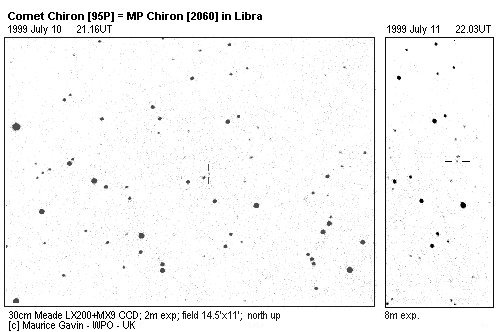
It reached 16m when at opposition in early June 2001 in Ophiuchus. Maurice Gavin obtained images of the comet on 1999 July 10 and 11.
It will reach around 18m when at opposition in July in Sagittarius.
Observations in ICQ format, last observation 1999 June 12, updated 1999 July 7.
Observations in ICQ format, last observation 2002 January 9, updated 2002 January 17.
Comet 96P/Machholz in 2007 96P/Machholz should reach 2nd magnitude as it passes through the satellite coronagraph fields at perihelion in early April, however it will be 9th magnitude by the time its elongation increases sufficiently for ground based observation in late April. UK observers may pick it up in the morning sky, but it will be a fading telescopic object. The orbit is very unusual, with the smallest perihelion distance of any proven short period comet (0.13 AU), which is decreasing further with time, a high eccentricity (0.96) and a high inclination (60�). Studies by Sekanina suggest it has only one active area, which is situated close to the rotation pole and becomes active close to perihelion. The comet may be the parent of the Quadrantid meteor shower.
It was a prominent object as it passed through the SOHO LASCO C3 coronagraph in early April. Juan Jose Gonzalez recovered it after perihelion on April 13.2, estimating it at 7.2 in 25x100B.
2 observations received give an uncorrected preliminary light curve of m = 13.9 + 5 log d + [15] log r
Observations in ICQ format, last observation 2007 April 15, updated 2007 April 16.
Comet 101P/Chernykh was discovered by Nikolaj Chernykh at the Crimean Astrophysical Observatory whilst scanning routine minor planet survey plates taken on 1977 August 19 and 22. It was a fairly bright object of 14th magnitude and at its best, at the end of September, it reached 12.5. The succeeding return was a little better, and this one is better again. The comet is an unusual one in playing celestial billiards with both Jupiter and Saturn and has made a number of approaches to both planets, most recently passing 0.35 AU from Jupiter in 1980, which reduced the period to 14 years.
The comet was observed to have split at the 1991 return, as reported on IAUC 5347 and IAUC 5391.
It comes into visual range in 2005 May, and reaches its brightest in the autumn, when it may get to 10th magnitude. It parallels the ecliptic, running from Aquarius into Pisces and remains visible into 2006.
The comet was recovered in July at 17th magnitude, and it seems likely that it won't get brighter than 15th magnitude, unless it has another outburst.
A secondary component was discovered at the end of November 2005, and this seems unlikely to be the same one that was seen in 1991.
Comet 102P/Shoemaker
Peter Birtwhistle recovered the comet at the 2006 return, allowing an
improved orbit to be computed, that includes non-gravitational parameters
and links the 1991 and 2000 returns. It is expected to fade from 14th
magnitude in late July 2006.
Comet 103P/Hartley An observation on 1997 October 4 made it 13.5 and a further observation on October 7.8 with 0.33-m L approximately 13.0. By October 21.7 it had brightened to 12.6, but was very diffuse and difficult to see. At the end of the month, on October 31.76 it had reached mag 10.8 in my 0.33-m Lx100, but was DC2, dia 2.7'. An observation in moonlight on November 10.77 put it at 10.6:, still very diffuse. On November 22.75 it had reached 9.9 in the same instrument. By November 30th it had become a little more condensed and was mag 9.5. Observations in early December put it at 9th magnitude and a binocular object.
In 1982 the comet made a close approach to Jupiter, and it was discovered by Hartley four years later, around nine months after perihelion. It was accidently recovered by T V Kryachko of Majdanak, USSR, on 1991 July 9.85, returning 5.6 days earlier than predicted. It was well observed by the section at this return and observations showed that the brightness peaked around 13 days after perihelion. This return is also a good one and for the northern hemisphere it is likely to be the brightest predicted periodic comet of the year. It is an evening object throughout the apparition and slowly brightens reaching 9m in late December when it is at perihelion. It will then slowly fade, but should remain observable until April. The orbit comes close to that of the Earth and it could produce a meteor shower at the descending node in November. Calculations by Harold Ridley gave a radiant of 19h56m +14�, some 5� Nf Altair, with a likely maximum around November 17. See also information from the IMO More recent calculations by Peter Brown of UWO suggest a likely maximum in early November, with a radiant in Cygnus.
The comet was a target for the extended mission of the Deep Impact spacecraft, renamed EPOXI. The encounter took place in October 2010, when the comet made a close approach to the Earth (0.12 AU) and was a large diffuse naked eye object. The spacecraft made its closest approach to the comet on November 4 at 14:02 UT The spacecraft captured some spectacular images of this very unusual object. A report on ground based observations made in support of the spacecraft mission appears in Astrophysical Journal letters, though only the abstract is free to read. The authors note a change in the rotation period from 16,4 hours prior to 2010 August to 19 hours in December.
Observations received in 1997 (289) give an uncorrected
preliminary light curve of
8.5 + 5 log d + 18.4 log r
or
8.3 + 5 log d + 0.042 abs (T-16.8) where T is the number of days
after perihelion
nearly identical with that from the previous apparition
Observations in ICQ format, last observation 1998 April 24, updated 1998 June 26
Observations received in 2010 (119) give an uncorrected
preliminary light curve of
9.1 + 5 log d + 0.045 abs (T-16)
Observations in ICQ format, last observation 2010 October 29, updated 2010 November 3
Comet 104P/Kowal Leo Boethin discovered a comet from the Philippines in January 1973, however due to a slow postal service it took some time to get the details to the CBAT and it was never confirmed. The comet was formally discovered by Charles Kowal in 1979.
Calculations by Kazuo Kinoshita reveal that it frequently passes close by Jupiter, and it has been gradually getting closer to the sun. The perihelion distance was 1.5 A.U. at the discovery in 1979, then reduced down to 1.4 A.U. in 1998, 1.2 A.U. in 2015, 1.1 A.U. in 2022 and 0.98 A.U. in 2033.
The comet was recovered by Spacewatch on 2003 August 31.20 with the LPL/Spacewatch II 1.8-m telescope when magnitude 21.
Observations received at the 1998 return give a preliminary light
curve of
10.5 + 5 log d + 11.0 log r
However Seiichi Yoshida notes that the absolute magnitude is very
variable from return to return, and that it outburst to 9.5 in 1972.
Observations in ICQ format, last observation 1998 April 23, updated 1998 October 5
Non- gravitational parameters A1 = +0.21 +/- 0.17, A2 = -0.0699 +/- 0.0025.
This was its third observed return and it remained at 13th - 14th magnitude from late October into January.
25 observations give an uncorrected preliminary light curve of 12.7 + 5 log d + [5] log r
Observations in ICQ format, last observation 2000 February 27, updated 2000 August 16.
The comet suddenly starts brightening very rapidly several months prior to perihelion passage, and reaches maximum brightness only within two months or so. In 2008, the beginning of the rapid brightening was delayed and the maximum brightness was fainter than 2001.Kazuo Kinoshita's calculations reveal that it passed 0.87 A.U. from Jupiter in 1984, and the perihelion distance was reduced from 2.7 A.U. down to 2.45 A.U. However, it passes only 0.71 A.U. from Jupiter again in 2023, and the perihelion distance will be increased up to 2.8 A.U. The current feature of brightening rapidly may disappear in the returns after 2035, and the comet may be much fainter than now.
Kazuo Kinoshita's calculations reveal that it will pass 0.63 A.U. from Jupiter in 2091, and the perihelion distance will be reduced down to 2.45 A.U.
Observations in ICQ format, last observation 2001 April 12, updated 2001 June 23.
Calculations by Kazuo Kinoshita reveal that it passed extremely close to Jupiter in 1976, down to 0.012 A.U. It will pass extremely close to Jupiter again in 2071, down to 0.037 A.U. Seiichi Yoshida notes that during these two approaches to Jupiter, the comet effectively rotates around Jupiter for a while, however the perihelion distance and eccentricity do not change much.
29 observations received give an uncorrected preliminary light curve of 9.7 + 5 log d + [25] log r
Observations in ICQ format, last observation 2000 February 27, updated 2000 May 29.
Comet 116P/Wild 116P/Wild 4 was discovered on 1990 January 21.98 by Paul Wild with the 0.40-m Schmidt at the Zimmerwald station of the Berne Astronomical Institute at a photographic magnitude of 13.5. At its brightest the comet only reached 12m, but it was surprisingly well observed. The comet was perturbed into its present orbit after a close approach to Jupiter in mid 1987.
The comet was at perihelion in January 2003.
Observations in ICQ format, last observation 2003 July 26, updated 2003 October 25.
Comet 117P/Helin-Roman-Alu Seichi Yoshida provides the following notes:
The orbit is almost circular with an eccentricity of about 0.2. However, it tends to be brightest a long time after perihelion passage.In the 1997 apparition it reached maximum brightness nearly one year after perihelion passage. At the discovery in 1989, it was already two years since the perihelion passage in 1987 October.
Kazuo Kinoshita's calculations reveal that the comet passed 0.68 A.U. from Jupiter in 2002 after the two apparitions, and the perihelion distance was reduced from 3.7 A.U. down to 3.0 A.U.
At the next return in 2005, it became brightest about 100 days after perihelion passage. The difference between the perihelion passage and the brightest day was reduced because the comet approached closer to the sun. But the asymmetric light curve with respect to perihelion passage still remains.
Kazuo Kinoshita's calculations reveal that the comet will pass near Jupiter twice at the end of 21st century, and the perihelion distance will be changed drastically. However it keeps the current orbit until that time.
Comet 118P/Shoemaker-Levyis no longer observable at this apparition.
Observations received (28) give preliminary light curves of
8.8 + 5 log d + [10] log r or 7.3 + 5 log d + [15] log r
Observations in ICQ format, last observation 1997 March 31, updated 1997 July 7
Comet 121P/Shoemaker-Holt was discovered by Carolyn and Eugene Shoemaker and Henry Holt with the Palomar 0.46-m Schmidt on 1989 March 9 and at its brightest reached around 13th magnitude. It made a moderately close approach to Jupiter in 1984 and does not approach closer to the Earth than 1.7 AU. With a period of just over 8 years, circumstances do not change much from apparition to apparition so a similar performance was expected for the 2004 - 2005 apparition, however it seems to have been a couple of magnitudes fainter. It should remain around 15th magnitude for the first three months of the year as it retrogrades in Leo Minor.
Comet 123P/West-Hartleyis 123P/West-Hartley was discovered by Richard West on an ESO survey plate taken on March 14 and independently by Malcolm Hartley on a UK Schmidt plate taken on May 28. The comet has made no recent close approaches to Jupiter. It reached between 13th and 14th magnitude at the last return in 1996. It should achieve a similar brightness this time round, but is at its brightest early in the New Year after its 2003 December perihelion.
Comet 128P/Shoemaker-Holt Seiichi Yoshida notes:
Kazuo Kinoshita's calculations reveal that it passed only 0.13 A.U. from Jupiter in 1982, and the perihelion distance was reduced from 4.2 A.U. down to 3.1 A.U. It was discovered in 1987 when it came into inner part of the solar system and became bright for the first time.In the next return in 1997, it became much fainter than at the discovery, by 3 mag when recovered. But it started brightening rapidly 4 months prior to the perihelion passage. After the perihelion passage, it reached to the same brightness as at the discovery.
In the next return in 2007, it was as bright as the previous apparition before the perihelion passage. But it kept faint, did not brighten as shown in the previous apparition, even after the perihelion passage.
The nucleus split into two pieces in 1997 apparition. The unusual brightening in that apparition was probably a temporary event due to the nuclear split. The comet should be usually 18-19 mag at best.
Kazuo Kinoshita's calculation revealed that it will pass only 0.28 A.U. from Jupiter in 2029, and the perihelion distance will be increased up to 4.1 A.U. again. The comet will be extremely faint, fainter than 22 mag at best, after that.
Comet 132P/Helin-Roman-Alu is no longer visible at this apparition.
Observations in ICQ format, only observation 1997 December 31, updated 1998 February 4
Comet 135P/Shoemaker-Levy Seiichi Yoshida provides the following information
Kazuo Kinoshita's calculations reveal that the comet approached Jupiter to 0.08 A.U. in 1988, and the perihelion distance was reduced from 5.2 A.U. to 2.7 A.U. It was discovered in 1992, when it passed perihelion at the new distance for the first time, when it reached to 16 mag. But at the next return in 1999, it only reached 18 mag. It has not yet been recovered at the 2007 return, and must be fainter still. The absolute magnitude of the comet has been fading, 7.5 mag in 1992, 8.5 mag in 1999, and fainter than 9.5 mag in 2007. Kazuo Kinoshita's calculations reveal that it will approach Jupiter again in 2047, and the perihelion distance will be increased to 3.6 A.U.
Comet 136P/Mueller The comet was recovered at its third apparition by the Remanzacco and Zvezdno Obshtestvo teams in 2007 July.
Observations in ICQ format , last observation 1999 May 1, updated 1999 August 12.
Donald Machholz discovered P/Machholz 2 (1994 P1) with his 0.25-m reflector at 10m in August 1994. It proved to have multiple components, first reported by Michael Jager (Vienna, Austria). The four secondary components could all be described by the same orbit, but with perihelion delayed by up to half a day from the primary. At times there seemed to be a faint trail of material linking the components. The comet has a short period of 5.2 years with a perihelion distance of 0.75 AU and aphelion just inside the orbit of Jupiter. The orbit has been slowly evolving, with progressive changes occurring about every 50 years, thanks to approaches to Jupiter. The most recent close approach was in 1982. With a relatively stable perihelion distance, which is slowly increasing, it is perhaps surprising that the comet was not discovered earlier. There was a favourable return in autumn 1978 when it might have reached 8th magnitude and very favourable returns in the autumns of 1920, 1937 and 1957 when it might have reached 6th magnitude. The fact that it was not discovered at any of these returns suggests either that the orbital evolution is slightly inaccurate, or that the absolute magnitude at the 1994 return was not typical. At present the earth passes about 0.25 AU outside the descending node and the orbital evolution will slowly decrease this distance, raising the possibility of meteor shower from the comet in a few hundred years time.
Zdenek Sekanina has published a paper on the 'Multiple fragmentation of comet Machholz 2 (P/1994 P1)' in Astronomy and Astrophysics, v.342, p.285-299 (1999). The abstract states:
Discovered in August of 1994, periodic comet Machholz 2 consisted of five condensations, A-E, of which D later became double. They were lined up along their common heliocentric orbit (with A being the leading and brightest component) and connected by a trail of material, suggesting that the comet's nuclear fragmentation was accompanied by a copious release of large dust particles. The earliest breakup is found to have occurred in late 1987, ~ 600 days before the comet's 1989 perihelion, giving birth to fragment B and the grand precursor of A. The precursors of A and D and fragments A and C appear to have originated, respectively, ~ 5 days prior to and right at perihelion. The last breakup episode during that same return to the Sun was the separation of E, probably from the precursor of D, ~ 600 days after perihelion. The division of D into D_1 and D_2 is the only event analyzed in this paper that occurred one revolution later, in 1994. The circumstances and implications of this fragmentation sequence are examined in detail and predictions are presented for 1999/2000.
Robert H. McNaught recovered component A of the comet on CCD images obtained with the 1.0-m f/8 reflector at Siding Spring on 1999 August 3.55.
This return was moderately favourable with the comet moving rapidly eastwards, through Aquarius, Cetus, Eridanus and Orion as it fades. The A component brightened significantly in the last week of 1999 and is now around 10th mag, though it is beginning to fade and become more diffuse. The D component is several magnitudes fainter and is unlikely to be seen. The comet is still several magnitudes fainter than expected. Martin Mobberley imaged the comet on December 29.75. and January 9 . David Strange also imaged it on January 9 . Visually it is a rather diffuse object and I made it 9.7 in my 0.33-m Dobsonian on January 9.74. By mid February it is unlikely to be observable.
42 observations give an uncorrected preliminary light curve of m = 11.7 + 5 log d + 0.0511 abs(t-T-20.6).
Observations in ICQ format , Last observation 2000 February 8, updated 2000 August 16.
C. E. Delahodde, European Southern Observatory, reported the recovery by O. R. Hainaut and herself of comet P/1994 A1 (= 1994a = 1993 XX) with the 3.6-m reflector on 2000 July 25.33. The indicated correction to the prediction by S. Nakano on MPC 31664 was Delta(T) = -0.10 day. [IAUC 7467, 2000 July 27]. No visual observations were made, but the comet was numbered.
The comet was recovered in 2008 with the Keck II telescope at Mauna Kea by K. Meech and J. Pittichova on June 18.51. It was observed with the Spitzer Space Telescope in July. It brightened extremely rapidly, reaching binocular visibility in winter 2008/9.
68 observations give an uncorrected preliminary light curve of m = -2.8 + 5 log d + 75 log r.
On 2001 Dec. 25, S. Nakano (Sumoto, Japan) reported that T. Oribe had apparently recovered comet P/1993 K2 (= 1993 XI = 1993l) the night before (December 24.86) with the 1.0-m reflector at the Saji Observatory. The position was within 2" of the prediction by B. G. Marsden on MPC 34423 (ephemeris on MPC 43696). No information was provided about the object's appearance other than m_1 = 19.5. The comet has now been independently reported by K. Sarneczky and Z. Heiner in 2002 Jan. 11 data obtained with the 0.6-m Schmidt at Piszkesteto, at m_1 = 20, but again with no information about the appearance. These observations confirm a tentative single-night detection by C. W. Hergenrother and D. Means of an object of stellar appearance (in an 840-s co-added exposure) at the comet's expected position a year ago with the Steward Observatory's 2.3-m reflector at Kitt Peak. [IAUC 7790, 2002 January 14]
Further to IAUC 7790, K. Sarneczky reports that his 300-s unfiltered CCD images taken on Jan. 11.2 UT show a diffuse, 8" coma and a faint, narrow, 13" tail in p.a. 283 deg. [IAUC 7792, 2002 January 15] Further to IAUC 7790, T. Oribe reports that his CCD images taken on 2001 Dec. 24.86 UT show a 0'.15 coma and an 8" tail in p.a. 295 deg. [IAUC 7794, 2002 January 17]
We will be able to follow it into the New Year as it continues to move north. It is an evening object, but its solar elongation decreases from 80� in November to 50� at the end of the year. It will not reach perihelion until 2003. By October it is moving north-eastwards in Capricornus and ends the year in Aquarius. It is currently fainter than expected.
F. Artigue, H. Cucurullo, and G. Trancredi, Observatorio Astronomico Los Molinos, Montevideo, report the recovery of comet P/1992 Q1 (= 1992p = 1992 XIV), mag 16.8, with a diffuse coma of diameter 20" and central condensation, on CCD images taken with a 0.46-m telescope in the course of the 'BUSCA' project on August 26.98 and 27.98. Further astrometry and orbital elements (from observations 1992 Aug. 28-2002 Aug. 28) appear on MPEC 2002-Q41; the correction to the prediction on MPC 40670 is Delta(T) = +0.52 day.[IAUC 7961, 2002 August 28]
Observations in ICQ format Last observation 2002 December 7, updated 2003 January 23.
S. Nakano, Sumoto, Japan, reports the CCD recovery of comet P/1986 A1 (= 1986a = 1985 XVIII) independently by T. Oribe (1.03-m reflector, Saji; diffuse coma of diameter 10", hint of tail toward the west on R-band images, mag 18.0) on September 9.78 and by A. Nakamura (0.60-m reflector, Kuma; diffuse with some central condensation, coma diameter 12", unfiltered images, mag 18.6) on September 12.81.
The indicated correction to the prediction on MPC 34423 is Delta(T) = -0.14 day. [IAUC 7969, 2002 September 13]
Observations in ICQ format Last observation 2002 December 11, updated 2003 January 13.
Keith Tritton provides the following information about the original disovery:
I'm amazed (and delighted) it's been recovered. It's quite a story - it was very faint on discovery in 1978 (I think it may even have been the faintest comet ever discovered at that time), when I was working on the Southern UK Schmidt Sky Survey. The orbit was observed over only a very short arc. The first return was very unfavourable, so it couldn't be seen, and the orbital inaccuracy was so large that the predictions for the second return had huge uncertainties. Nevertheless I got some plates taken at the Schmidt (this was about 1990) and sent to me in Cambridge for searching. But I never got them, they were lost in transit from Australia!So I never expected to hear anything more about it. It must be rather rare to pick up a lost comet on its fourth return, mustn't it?
P. Holvorcem, Campinas, Brazil, has reported that the co- addition of three 45-s unfiltered CCD images of a fast-moving object found by C. Juels, Fountain Hills, AZ, with a 0.12-m f/5 refractor and a 0.5-m f/4.8 reflector on October 6.44 show a coma of diameter 2' and a hint of a 1'.5 tail at p.a. roughly 257 deg. Following posting on the NEO Confirmation Page, additional CCD observers noted the object's cometary appearance, including R. Trentman (Louisburg, KS, 0.75-m reflector; mag 13.1 and very faint evidence of a tail approximately 10" long in p.a. approximately 280 deg on Oct. 7.4 UT), D. T. Durig (Sewanee, TN, 0.30-m f/5.86 reflector; teardrop-shaped coma of mag 10.1 with a tail at least 2'-2'.5 long in p.a. about 285 deg on Oct. 7.4), and J. Young (Table Mountain, CA, 0.6-m reflector; 36" coma elongated to 48", with a 3' tail in p.a. 289 deg with a very straight and extremely thin jet of length about 1'.5 in its center on Oct. 7.5).
Following a suggestion by S. Hoenig (Dossenheim, Germany) from orbital computations by M. Meyer (Kelkheim, Germany), B. G. Marsden (Smithsonian Astrophysical Observatory) has shown that this comet is identical to the lost comet 1978d = 1977 XIII = D/1978 C2 (Tritton), which was observed for only a month (cf. IAUC 3175, 3186, 3194, 3198). The available astrometry, including Sept. 22 prediscovery observations, and the orbital elements by Marsden appear on MPEC 2003-T37. [IAUC 8215, 2003 October 7]
Observations in ICQ format, last observation 2003 October 8, updated 2003 October 25.
S Nakano has identified the comet with 1979 O1, observed by Charles Kowal on three occasions between July 24 and 27 and then lost. The orbit was uncertain, but noted as possibly being periodic due to the low inclination.
An apparently asteroidal object with not-unusual motion, found by LONEOS on October 16.40 (the discovery observation together with other astrometry appeared on MPS 88336, 90581, and 91035 with the designation 2003 UD_16; initial orbit on MPO 53844), has been found by C. W. Hergenrother to show a circular, condensed 11" coma and no tail on co-added 900-s R-band CCD exposures taken on Nov. 30 with the Mt. Hopkins 1.2-m reflector (astrometry below measured by T. B. Spahr). [IAUC 8248, 2003 December 3]
Maik Meyer found images of the comet on Palomar plates taken in 1989 and 1991, thus allowing a secure orbit to be determined.
Maik Meyer provides the following information on the linkage with the NEAT images:
Comet precovery by Maik Meyer [from http://www.hohmanntransfer.com/mn/0409/20.htm]It came right after my little son went to bed and I was preparing for a comet observing session, so I had time without family duties. I quickly checked for earlier images of this comet and SkyMorph indicated two days in 1996 in NEAT data with an asteroidal brightness of 18 mag. I was not very hopeful but almost fell off my seat when I saw the bright 16-mag. comet with a coma and a tiny tail on my screen.
I quickly measured the two days, composed the message to the MPC, and, when I came back from my comet observing, MPEC 2004-S18 had been issued containing the observations and updated orbits for the 1996 and 2004 apparitions. I still wonder why this one slipped through NEAT's detection, because it is so obvious. Now this comet will become numbered ? my second precovery which leads to a permanent numbering after 159P/LONEOS.
Observations in ICQ format, last observation 2004 October 13, updated 2004 October 19.
Rob McNaught has recovered comet P/Hartley-IRAS (1983v=2004 V2) with the Siding Spring 1-m reflector. The comet was 4.8 days behind the prediction in the 2004 ICQ Handbook. At 19th magnitude it is a little fainter than might be expected.
For the 2005 return 17 observations give a preliminary light curve of 9.0 + 5 log d + [10] log r.
The 14th magnitude object was discovered by Rob McNaught during the Siding Spring Survey on October 10.55. It will fade. It has been linked to objects seen in 1990 (by the Palomar Sky Survey), 2000 (by LINEAR and LONEOS) and by ESO, AMOS and NEAT in following years, so the orbit is secure and it was numbered 162. It has a period of 5.32 years, with perihelion at 1.23 AU and was at perihelion on November 10.
Maik Meyer has found images of the comet on Palomar DSS plates from 1990 and 1991, and NEAT images from 1997. This gives a secure orbit and lead to the comet being numbered 163.
David Herald recovered comet 1998 W2 (P/Hergenrother) on images taken with his 0.36m f4 SC reflector on 2005 July 4 & 5. The comet was 0.27 days ahead of the prediction on MPC 45658. The comet may reach 16th magnitude in the autumn. Following recovery it has been numbered 168.
In November 2009 Alan Watson spotted a bright comet in STEREO images, which was identified with 169P. Ground based observations by Juan Jose Gonzalez on November 18.8 gave a magnitude of 9.2. He noted that he had also observed it as a 10th magnitude object at its return in September 2005. An article on the likely brightness of 169P/NEAT by Joe Marcus in ICQ suggests that part of the anomolous brightening was due to forward scatter.
Further observations show that it is a periodic comet with period of 8.6 years and will reach perihelion at 2.93 AU in late January 2006. It has been identified in observations made by NEAT in 1997, so the orbit is now secure and the comet has received a numeric designation.
Comet P/Spahr was recovered as 2005 R3 by F. Fratev and E. Mihaylova of Zvezdno Obshtestvo Obsevatory, Plana, with a 0.25-m f/4.7 reflector and by E. J. Christensen with the Catalina 0.68-m Schmidt telescope. The prediction in the 2005 Handbook requires a correction of delta T = -0.2 day. Following recovery the comet was numbered 171.
An apparently asteroidal object of 20th mag discovered by William Kwong Yeung, Benson, AZ, on CCD images taken with a 0.45-m reflector near Apache Peak on Jan. 21.49 UT was identified by the Minor Planet Center with additional apparently asteroidal observations (including some in 1998 and 2000-2001) made at several observatories through its routine processing. Noting the unusual nature of its orbit, T. Spahr obtained unfiltered CCD observations with M. Calkins at the 1.2-m reflector on Mount Hopkins on May 5, 6, and 7 that show the object (m_1 about 17) larger than nearby stars of similar brightness and with a persistent faint tail about 5" long in p.a. 315 deg. [IAUC 7986, 2002 May 9]
It was numbered 172 in September 2005 following identification of images on Palomar Sky Survey plates from the previous apparition in October 1993. Pre-discovery images by Spacewatch in 1998, and LINEAR in 2000 were also identified.
The case seems similar to that of Chiron, which is (2060) 95P/Chiron, so the object should receive a cometary number. Roll on comet Pluto!
The Committee on Small Bodies Nomenclature has agreed to give the comet P/2000 EC_98 (cf. IAUC 8656, 8660) the same name as the centaur minor planet (60558), Echeclus (cf. MPC 55988), which has been assigned also the permanent comet number 174P (MPC 55911). [IAUC 8677, 2006 February 22]
Observations made since December 2005 appear to indicate that the main source of activity is a secondary body moving independently of the primary, possibly on a hyperbolic orbit. The object was at maximum elongation from the primary around February 25. It may be an escaped satellite or a debris fragment.
Michael Jaeger imaged the comet on 2011 May 30, finding it to be in outburst at 15th magnitude.
The Committee on Small Bodies Nomenclature has announced that P/2000 C1 = P/2006 A3 (Hergenrother) has been assigned the number 175P (cf. IAUC 8664). [IAUC 8677, 2006 February 22]
In June 2006 the Committee on Small Bodies Nomenclature agreed to name and number the comet, although the asteroidal designation will be used for archiving any astrometry.
As is often the case, early magnitude estimates by CCD observers were approximating to m2 rather than the published m1 and by mid July the comet was reported at around 10th magnitude.
50? observations received give an uncorrected preliminary light curve of m = 9.2 + 5 log d + 21.7 log r
D Tibbets and Gary Hug recovered comet 1999 X1 (Hug-Bell) on July 16.40 with the 0.7-m relector at the Farpoint Observatory Eskridge, Kansas. The correction to the perihelion time predicted on MPC 48383 was -0.12 day.
Following recovery it was numbered 178P.
J. L. Ortiz and A. Mora recovered comet 2001 K1 (P/NEAT) on CCD images obtained with the 2.5-m Isaac Newton Telescope at La Palma. The images were measured by Reiner Stoss. The comet was essentially stellar and magnitude 22. The indicated correction to the prediction on MPC 54169 is Delta(T) = -0.4 day. This confirms a tentative identification made by Reiner of the comet on Palomar Sky Survey plates from 1955.
Eric Christensen recovered comet 2001 WF2 (P/LONEOS) with the Catalina Sky Survey 0.68-m Schmidt on 2006 November 18.27. The comet was 20th magnitude and the indicated correction to the elements on MPC 51822 is Delta(T) = -0.05 day.
Eric Christensen recovered 1999 DN3 (P/Korlevic-Juric) with the Mt Lemon 1.5-m on December 16.36. The comet was 20th magnitude, and the indicated correction to the prediction on MPC 54168 is Delta(T) = -2.0 days. Perihelion is at 3.9 AU in May 2008 and the comet has a period of 9.6 years.
Maik Meyer found some prediscovery observations in archive imagery from 1996 and 1975, which should lead to numbering of the comet.
I managed to find this comet in three DSS images after playing around with orbits and finding the anchor point with the 1996 images. It should be visible in a plate of 1995, but was not seen. Also I could not find it in some NEAT images. In the 1975 images the comet is quite bright, probably due to the slow motion. The appearance is almost the same in the two different plates, although at a different position. I have taken the position of the center of the short trail. The 1996 image is involved with a star. Here I could only measure the end of the trail.Hirohisa Sato has computed a new orbit linking the apparitions. Subsequently to Maik's identification, Gareth Williams identified a comet, reported by Russell Eberst in 1978 from UK Schmidt plates taken at Siding Spring in 1977 and designated as 1977 O1 as being the same comet. With observations at three returns the comet is now likely to be numbered 186P. The brightness of the object does seem rather more variable than expected for such a distant object, so it may be subject to occasional outbursts, much as 29P/Schwassmann-Wachman.
Seiichi Yoshida notes that:
The perihelion distance is large at 4.3 A.U., and the orbit is almost circular with an eccentricity of 0.12. Kenji Muraoka's calculation revealed that this orbit does not change significantly for 200 years in the 20th and 21st centuries.It reaches 17.5 mag at best based on the brightness at the discovery in 2007 January. The brightness in 1996 February was similar, however, the comet was unexpectedly bright at 15.5 mag in 1975 May and June. It seems to have been a temporary outburst, as the comet returned to its normal brightness in 1977 July at 18 mag.
This comet is similar to 111P/Helin-Roman-Crockett; large perihelion distance, almost circular orbit, and a record of unexpected brightening in temporary outburst.
Eric Christensen recovered comet 1999 J5 (P/LINEAR) in images taken on March 9 during the course of the Mount Lemmon Survey, with additional images taken by R A Kowalski on March 10. The indicated correction to the prediction on MPC 54170 is Delta(T) = -0.8 day.
Seiichi Yoshida notes:
This is a new periodic comet discovered in 1999. At the next return in 2008, it became fainter by 2 mag.Kazuo Kinoshita's calculations reveal that the perihelion distance has been almost constant at 3.6 - 3.7 A.U. since 1952. Therefore, the brightness of the comet should be also stable.
In the 1999 apparition, the comet was not observed in 2000, one year after the discovery, although it must have been almost as bright as at the discovery. It suggests that the comet was temporarily bright in outburst in 1999.
Rob McNaught recovered comet P/1998 S1 with the 0.5-m Uppsala Schmidt at Siding Spring on 2007 May 13 and Jim Scotti independently recovered it with the Spacewatch 1.8-m f/2.7 reflector at Kitt Peak on June 26.5. The indicated Delta(T) correction to the prediction on MPC 51824 is +0.03 day.
The preliminary orbit suggested that it was in a short period orbit with P around 5 years and was near perihelion. It is intrinsically very faint (H0=19). The orbital period is the third shortest of current P/ comets. At a favourable return it can pass 0.2 AU from the Earth.
Comet 2002 O5 (P/NEAT) was recovered independently at three observatories in mid July as 2007 N2: by LINEAR in New Mexico, and by G. Lombardi and E. Pettarin at Farra d'Isonzo, Italy and F. Fratev and E. Mihaylova at Plana, Bulgaria. It was around 16th magnitude. The correction to the predictions on MPC 51823 was Delta(T) = -0.36 day.
Comet 1998 U2 was recovered by L. Buzzi and F. Luppi, Varese, Italy on 2007 July 26 on CCD images obtained with a 0.60-m reflector. Peter Birtwhistle made confirming CCD observations on July 27. The indicated correction to the predictions on MPC 51823 is Delta(T) = +0.3 day.
Images from August and November 2000 were found in archival LONEOS and NEAT observations by Syuichi Nakano in early September and it was given the designation 2000 P3 for this return. Following publication of the identification on MPEC 2007-R04 further images from September and December 2000 were found in the NEAT archives by Maik Meyer and Reinder Bouma.
192P is a bright periodic comet, which was not discovered until 1990. At the discovery, it had already passed perihelion two months before, and faded out rapidly. So, it was supposed to be a temporary outburst. But it was observed at the same brightness in the next return in 2007.This comet tends to brighten and fade out rapidly, and the light curve is asymmetric to the time of perihelion. It reaches maximum brightness about 50 days after perihelion passage.
Kazuo Kinoshita's calculations show that the orbital elements of this comet have not changed much since 1888. So it is expected to show the same light curve in every apparition.
Additional astrometry and orbital elements by B. G. Marsden (from 35 observations, Aug. 17-29) appear on MPEC 2001-Q69 [IAUC 7697, 2001 August 29] The comet was at perihelion in June and will not get significantly brighter. It has a period of 6.6 years. This is LINEAR's 65th comet.
Observations in ICQ format, last observation 2001 October 10, updated 2001 October 17.
Comet 2001 Q5 (P/LINEAR-NEAT) was recovered by K. Sarneczky and L. L. Kiss with the 2.3-m reflector at Siding Spring on October 21.45. The indicated correction to the prediction on MPC 54167 is Delta(T) = -0.5 day.
Comet 2000 B3 (P/LINEAR) was recovered by L. Buzzi and F. Luppi on CCD frames taken with a 0.60-m f/4.64 reflector at Varese, Italy on November 17.07. The indicated correction to the prediction on MPC 54167 is Delta(T) = +0.16 day.
Following further observations in 2007 September and December, and the publishing of new elements on MPEC 2007-X14 [2007 December 3], S. Foglia, R. Matson, and M. Tombelli identified images of the comet on two UK Schmidt plates from 1993 and 1994. The linked orbit has a period of 16.5 years.
M. Tichy and J. Ticha, Klet Observatory, recovered comet P/2000 U6 (cf. IAUC 7515) on CCD images obtained on February 3rd with the 1.06-m KLENOT Telescope. They subsequently identified earlier images from January 11. The indicated correction to the prediction on MPC 54167 is Delta(T) = -0.16 day.
Another apparently asteroidal LINEAR object found on May 23.16, announced on MPEC 2003-K27 as 2003 KV_2 (see also MPEC 2003-K38 and 2003-K47), has been found cometary on R-band images taken by C. Brinkworth and M. Burleigh on May 28.9 and 29.9 UT with the 1-m Jacobus Kapteyn Telescope on La Palma (communicated by A. Fitzsimmons), in which the object shows a tail about 4"-5" long in p.a. 125 deg and a small coma that is somewhat larger than the surrounding field stars. The preliminary orbit shows a passage 0.55 AU from Jupiter in Jan. 2001, before which the perihelion distance was somewhat larger. [IAUC 8139, 2003 May 30]
After posting an asteroidal object discovered by the Catalina Sky Survey on the NEOCP Sergio Foglia suggested an identity with comet 2003 KV2 (LINEAR), indicating a correction of Delta(T) = +0.8 day to the prediction by Nakano on MPC 56801.
In March 2008, Gareth Williams identified images of comet P/1998 X1 taken at its 2006 return. He found that Spacewatch images taken between January and March and Mt Lemmon images from March show the comet, which was around 21st magnitude. The indicated correction to the orbital elements on MPC 45656 is Delta(T) approximately -2 days. The observations from the two apparitions do not fit together very well, leaving residuals of up to 5".
Brian Marsden notes on MPEC 2008-G10 [2008 April 2]
The rediscovery of this comet by G. V. Williams in 2006 astrometric survey data was announced on 2008 Mar. 31 on IAUC 8929-8930, with the 2006 observations simultaneously published on MPEC 2008-F63, together with another triplet of 1999 observations. This rediscovery appears to be consistent with E. J. Christensen's tentative single-night recovery observations in 2005 October. As noted on IAUC 8929, however, the linked orbit computation was decidedly unsatisfactory. This was also true of attempts to include the A1 and A2 nongravitational parameters. Following a demonstration by S. Nakano of the apparent need also to include the A3 parameter, linked orbital elements were obtained by G. V. Williams from such a solution. The resulting nongravitational parameters are A1 = -2.79 +/- 0.27, A2 = +1.1966 +/- 0.2612, A3 = -2.2588 +/- 0.0268.
Spanish CCD observers reported the comet in outburst in early August, and this was confirmed by other CCD observers. Juan Jose Gonzalez Suarez made a visual observation on August 4.92, estimating it as a nearly stellar object of magnitude 14.4.
J. V. Scotti recovered comet P/1997 V1 (Larsen) with the Spacewatch 1.8-m f/2.7 reflector at Kitt Peak on June 9.44. The indicated correction to the prediction on MPC 54170 is Delta T = -2.0 days. This is the 200th comet to be numbered, although several SOHO comets have been observed to return and not numbered.
Improved orbital elements were published on MPEC 2001-S05, including prediscovery observations on Aug. 19 by LINEAR by B. G. Marsden and these indicate that this comet passed only 0.014 AU from Mars on 2002 Jan. 10.7 TT, as first suggested by C.-I. Lagerkvist (Uppsala) and G. Hahn (German Aerospace Center, Berlin). [IAUC 7720, 2001 September 19] The comet has a period of 6.5 years and was at perihelion on 2002 February 17.
Comet 2001 R1 (P/LONEOS) was recovered by Michael Jaeger from Stixendorf, Austria on August 31.09 as a 17th magnitude object. It was confirmed by Giovanni Sostero and team from the Skylive Observatory, Catania, Italy the following night. The comet is a month past perihelion and will fade. Following posting of the recovery on the comet-ml Maik Meyer located NEAT images on frames from 2001 August. The indicated correction to the prediction on MPC 54169 is Delta T = -0.42 day.
Jim Scotti recovered his comet (P/2001 X2) on Spacewatch images taken with the 1.8-m reflector at Kitt Peak on 2008 September 5.43 as a 21st magnitude object. The indicated correction to the prediction on MPC 56802 is Delta(T) = -0.15 day. Pre-recovery images were found on Mt Lemmon frames from 2007 September and October, and Spacewatch from 2008 August.
The comet passed 0.67 AU from Jupiter on 1960 March 24.
An orbit by Syuichi Nakano links the comet with asteroid 1929 WW.
Gareth Williams identified images of 1999 WJ7 in incidental astrometry taken with the 0.9-m Spacewatch telescope on September 3.24. The comet was 20th magnitude, with perihelion in 2010 February. The indicated correction to the prediction on MPC 59598 is Delta(T) = -0.3 day.
The comet passed within about 0.1 AU of Jupiter in 1985, prior to which it was in a more distant, less eccentric orbit.
Gareth Williams identified images of 2001 TU80 in incidental astrometry taken with the 1.8-m Spacewatch telescope on September 8.43. The comet is at perihelion in December. The indicated correction to the prediction on MPC 54171 is Delta(T) = -0.3 day.
Koichi Itagaki (Teppo-cho, Yamagata) and Hiroshi Kaneda (Minami-ku, Sapporo) discovered a 13th magnitude comet on unfiltered CCD patrol frames taken on September 10.56 UT using a 0.21-m f/3 reflector. A confirming unfiltered CCD image was taken subsequently with a 0.60-m f/5.7 reflector at Yamagata, where the comet was diffuse with strong condensation, with a coma diameter of about 25" and a 2' tail toward the east-southeast.
Maik Meyer, Limburg, Germany, suggested that the comet was identical to comet 1896 R2 (D/Giacobini), which had not been seen since January 1897 and for which a prediction by Nakano gave T = 2008 September 9.89. This prediction was included in the BAA listing for the comets expected in 2008. Richard Buckley made a prediction for its return in 1975, which was published in the Journal in 1977. The identity has been confirmed by Nakano, who notes that the comet has made 17 revolutions and passed only 0.51 AU from the earth on 1962 September 9 and 0.81 AU from Jupiter on 1992 January 14. The linked orbit shows that the comet was at perihelion on September 10.21. It also suggests that Buckley's prediction was out by roughly six days.
The fact that the comet was not recovered on previous occasions, and that it is now past its brightest for this return, suggests that the comet might have been found in outburst, although it was expected to reach 11th magnitude based on the discovery apparition. Further confirmation of this suggestion was made when D. T. Durig and K. N. Hatchett, Cordell-Lorenz Observatory, Sewanee, Tennassee, USA reported observations of two additional components, which have perihelion times differing by Delta(T) = +0.014 and +0.133 day. Zdenek Sekanina suggests that the two fragments separated from the parent some time ago. The one closest to the parent (B), separated in the second half of 2006, around 700 days before perihelion. Fragment C separated at the end of 1998, three years before the last return to perihelion. In both cases the comet was over 4.5 AU from the Sun at the time.
The comet was the first one to be discovered photographically, by E E Barnard from the Mount Wilson Observatory on 1892 October 12. It was very faint and only followed until December 8. The apparition was not a particularly favourable one and the comet was last observed a few days before perihelion. The calculated orbit suggested that no favourable returns were likely for some years and the comet was lost. Richard Buckley published a paper on missing comets in the BAA Journal in 1977 (BAAJ, 87, No3) and gave a prediction for a return in 1976.
As hinted on IAUC 7625, this is a short-period comet, and observations by C. W. Hergenrother, T. B. Spahr, and M. Nelson with the 1.8-m f/1 VATT Lennon telescope on May 27 make it clear that the orbital period is $P$ about 7.5-7.9 years. Spahr has also identified the comet with a very faint object (not described as cometary) discovered by A. E. Gleason with the Spacewatch telescope on 2000 Oct. 7 and placed on The NEO Confirmation Page but removed on Oct. 20 for lack of follow-up. The additional astrometry and orbital elements ($P$ = 7.64 yr) are given on MPEC 2001-K43. S. Nakano has noted some rough similarity to the orbit of comet 3D/Biela. [IAUC 7635, 2001 May 29]
Brian Marsden has provided some additional information about this possibility: While I cannot exclude with 100-percent certainty the possibility that the new comet P/2001 J1 (NEAT) is the long-lost 3D/Biela, I really don't think it is.
What, indeed, happened to 3D/Biela after 1852? Did it break up completely? Some 30 years ago I looked into the possibility of finding that comet again and published a number of different orbits based on different possibilities for the action of the nongravitational forces on the comet after 1852. For an epoch around 1971 these orbits all had perihelion distances under 0.83 AU and inclinations to the ecliptic under 8.1 degrees.
Coming now to the recent comet, although unusually large inconsistencies among the observations made it particularly difficult to establish the orbit, and given that the comet's position in the sky makes it difficult to observe, I note that some careful observations on May 27 by Carl Hergenrother and Tim Spahr with the Vatican Advanced Technology Telescope in Arizona isolated the revolution period to 7.5-7.9 years. Tim then realized that the object had in fact been reported as unusual--though not of cometary appearance--by Arianna Gleason at Spacewatch on October 7 last year. The object was then listed on The NEO Confirmation Page for almost two weeks, although it was obviously too faint for essentially all of the likely follow-up observers, and Spacewatch itself evidently just missed the comet's position when it recorded the region again on October 19. The October 7 linkage is clearly correct, and this pins down the current period as 7.64 years.
Running this orbit back gives a moderately close approach to Jupiter (0.8 AU) in 1972, before which the P/2001 J1 perihelion distance was 0.96 AU and the inclination 11 degrees. While there was tolerably good agreement in orbital eccentricity, argument of perihelion and nodal longitude, it is difficult to reconcile the perihelion distance and inclination with the 3D/Biela values. To get these elements to agree would require the nongravitational forces to act in some special way, together with the gravitational effects of occasional approaches to Jupiter.
Whether or not the comets are identical, why was the current comet not observed earlier in the twentieth century? After all, the perihelion distance of under 1 AU does allow moderately close approaches to the earth--with a minimum orbital distance of perhaps 0.15 AU and an actual minimum distance of perhaps 0.5 AU in 1955. Actually, it is quite clear that at many passages through perihelion the small elongation from the sun would completely preclude observations, and by the time the object had moved around to opposition it would be as faint as when Spacewatch fortuitously observed it last October. Even under the more favorable circumstances of the 1955 perihelion passage, the best one could hope for at a 90-degree elongation from the sun would be magnitude 15, and more typically (as this year), one would have to contend with a maximum elongation of 70-80 degrees and magnitude 16 if one were lucky. We _were_ lucky that NEAT was observing this year so far from opposition, and there would have been no observing program with the capability of making the discovery at the previous comparable elongation in 1985. Unless the comet is now anomalously faint, that it escaped prior detection is fully reasonable--a situation not a bit like that of 3D/Biela on several occasions in the late eighteenth and early nineteenth centuries.
Ken-ichi Kadota, Ageo, Saitama-ken, Japan recovered comet 2001 J1 (P/NEAT) on CCD images obtained with his 0.25-m f/6 reflector on October 15.78. Confirming observations were also made by H. Abe (Yatsuka-cho, Shimane-ken, Japan, 0.26-m reflector). The indicated correction to the prediction on MPC 54170 is Delta(T) = -0.6 day.
In 2008 December, S Nakano linked the comet with previously unreported observations of an 18th magnitude object obtained by LONEOS in September and October 2000. This return is now designated 2000 S7. The new orbit shows that the comet passed 0.18 AU from Jupiter on 2004 July 8.
An apparently asteroidal object discovered by the LINEAR project on February 3.40 has been found to show a narrow 1'.1 tail in p.a. 274 deg (slightly expanding toward the end) on CCD images obtained by R. H. McNaught with the 1.0-m f/8 reflector at Siding Spring on Mar. 30.8 UT. Following a request by the Central Bureau, M. Kocer reports that CCD frames taken at Klet on Mar. 31.145 also show a narrow tail about 90" long in p.a. approximately 280 deg. [IAUC 8314, 2004 March 31]
Gary Hug recovered 2004 CB (P/LINEAR) on 2008 December 4.39 as an essentially stellar object of 20th magnitude. The indicated correction to the prediction on MPC 56803 is Delta(T) = +0.16 day.
Eric Christensen, Lunar and Planetary Laboratory, reports the discovery of a 15th magnitude comet on May 26.18 by the Catalina Sky Survey on CCD images taken with the 0.7-m Schmidt telescope. Following posting on the NEO Confirmation Page, many observers noted the obvious cometary nature of the object on CCD images taken during May 27.1-27.2 UT, including R. Elliot (Fall Creek, WI; coma diameter about 10"), P. R. Holvorcem and M. Schwartz (near Nogales, AZ; coma diameter about 35", with a 30" tail in p.a. 106 deg), J. Young (Table Mountain, CA; 10" coma and a very faint 40" tail in p.a. 115 deg with a slight curve halfway along its length to p.a. 130 deg), and J. McGaha (Tucson, AZ; coma diameter 12", with slight nuclear condensation and a 6" tail). [IAUC 8136, 2003 May 27]
It has been noted by numerous individuals that the preliminary orbital elements of comet C/2003 K2 (cf. IAUC 8136) place it close to the position of an unconfirmed object found on SWAN ultraviolet SOHO website images and reported to the Central Bureau on Apr. 14 by X.-m. Zhou (Bo-le, Xin-jiang, China). Measurements of the object on six dates, Apr. 5-19, were forwarded to the Central Bureau by Zhou (via D. H. Chen), by M. Mattiazzo, and by S. Hoenig; the positions differed considerably, due to the poor resolution of SWAN (uncertainty on the order of 1 degree). Two search ephemerides based on various positions were circulated by the Bureau to numerous visual and CCD observers in the hopes of optical confirmation, but the searches (undertaken during the last week of April by Zhou, A. Hale, Mattiazzo, Y. Kushida, and Y. Ezaki) revealed nothing to as faint as mag 14.5. The following improved parabolic orbital elements for C/2003 K2 (from MPEC 2003-K49) indicate that the search-ephemeris positions in late April for the SWAN object were no closer than about 2.5 degrees from C/2003 K2. The comet might be of short period. [IAUC 8138, 2003 May 30]
Attempts at recovery by Maik Meyer in November 2008 were unsuccessful, with the comet not being found down to 18th mag along the line of variation +/- 9 days.
Alan Watson found a 10th magnitude comet on SECCHI HI1-B images taken on December 8.24 Rainer Kracht made measurements of the object's position and computed a parabolic orbit, from which Maik Meyer suggested identity with comet P/2003 K2. The indicated correction to the prediction on MPC 56802 is Delta(T) = -22 days.
Rob Matson reports that the comet was visible in SWAN imagery from December 4, but was moving slowly in a location close to the occulting region. If anyone took an image of the planetary conjunction of Venus and Jupiter in early December it is just possible that they might have captured the comet, although for UK observers it would be very close to the horizon.
The comet passed through the SOHO LASCO C3 field between December 20 and 26, but at 9th magnitude would probably not have been detectable. However Piotr Guzik pointed out that the geometry is strongly forward scattering and the magnitude could be enhanced by 5 - 6 magnitudes around December 23. Joe Marcus suggested that the forward scattering could be sufficiently strong to enhance the brightness by as much as 6.5 magnitudes, making it a prominent object in the SOHO fields. On December 21.8 it was easily visible in the C3 field at about 8.2, along with two Kreutz comets. The comet emerged into the morning sky in January. Few observations have been made, but it appears to be fading relatively slowly.
5 observations give an uncorrected preliminary light curve of m = 9.4 + 5 log d + [5] log r.
Calculations by Hirohisa Sato allow for the possibility of an elliptic orbit of period 11 years and perihelion at 2.0 AU in early June 2009. This was confirmed by subsequent orbits, which give a period of 6.7 years and perihelion 2.4 AU in 2009 May.
With an improved orbit, Maik Meyer subsequently found previously unidentified images of the comet on frames taken by NEAT on 2003 March 24 and LONEOS on 2003 April 1. The comet was given the designation 2003 F6 at this return, which had perihelion on 2002 August 19.1.
Observations in early January 2009 showed a coma, and so with observations over two returns and a secure orbit it was numbered 212.
Comet 2005 R2 (P/Van Ness) was recovered by Gary Hug with his 0.56-m reflector at Sandlot Observatory on January 31.36. It was 21st magnitude. The indicated correction to the prediction on MPC 62889 is Delta(T) = -0.1 day.
It became brighter than expected in 2011 and a secondary condensation was observed by Giovanni Sostero, Nick Howes, Helen Blyth and Ernesto Guido in images taken with the Haleakala-Faulkes Telescope North on August 5.5, and subsequently seen in images by J. Gonzalez at the end of July and early August. Orbital calculations by Hirohisa Sato suggest that the split occurred in 2007 or 2008. Following an alert from a Japanese observatory, the team observed an additional componenet in September. The continued fragmentation may explain why the comet has remained brighter than expected.
An object reported as asteroidal by LINEAR (discovery observation below), given the designation 2002 CW_134 on MPS 50314, and later placed on the NEO Confirmation Page, has been found to show cometary activity: Mar. 19.0 UT, diffuse with coma diameter 13" (M. Tichy and M. Kocer, Klet, 1.06-m reflector); Mar. 23.0, diffuse, faint coma extended about 30" in p.a. 330 deg (G. Masi and F. Mallia, Campo Catino, Italy, 0.8-m reflector).
     2002 UT             R.A. (2000) Decl.        m2
     Feb.  7.47271   12 52 46.90   - 5 33 17.2   20.1
Jul 06 Bo Zhou reports a Kreutz group comet in C2 image
Jul 07 Periodic comet 2011 N1 discovered
Jul 07 Rob McNaught discovers comet 2011 N2
Jul 08 Sergey Shurpakov reports a Kreutz group comet in real time C3 images
[IAUC 7858, 2002 March 23]
Comet 2002 CW134 (P/LINEAR) was also recovered by Gary Hug with his 0.56-m reflector at Sandlot Observatory on January 31.49. It was 20th magnitude. The indicated correction to the prediction on MPC 56802 is Delta(T) = -0.32 day.
It is in a periodic orbit of 8.1 years and perihelion at 3.2 AU and is a Jupiter family comet.
Comet 2002 O8 (P/NEAT) was also recovered by Gary Hug with his 0.56-m reflector at Sandlot Observatory, on January 22.49. The comet was 20th magnitude. The indicated correction to the prediction on MPC 59599 is Delta(T) = -0.34 day.
Comet 2001 CV8 (P/LINEAR) was recovered by Jim Scotti with the Spacewatch 1.8-m reflector on 2009 February 19.53. The indicated correction to the prediction on MPC 54170 is Delta(T) = -0.37 day.
The comet became about 5th magnitude at its brightest, with 39 visual observations giving a preliminary uncorrected light curve of 11.3 + 5 log d + [10] log r
The comet was recovered by Ernesto Guido, Giovanni Sostero and Paul Cammileri on 2009 March 17.50 using remote telescopes in the USA (the RAS Observatory 0.25-m reflector near Mayhill, NM) and in Australia (the 0.35-m reflector at Grove Creek Observatory, Trunkey, N.S.W.). The comet was 18th magnitude. The indicated correction to the predictions on MPC 56804 is Delta(T) = +0.01 day. It is a reasonably favourable return and the comet could reach 12th magnitude near the time of perihelion, coming into view for UK observers in August.
32 visual observations give a preliminary uncorrected light curve of 10.3 + 5 log d + 12.3 log r
M. Bezpalko, Lincoln Laboratory, Massachusetts Institute of Technology, reports the discovery by LINEAR of a comet with a tail in p.a. 270 deg on images taken on Apr. 29.3 UT. Following posting on the NEO Confirmation Page, other CCD observers have also reported the object as cometary, including G. J. Garradd (Tamworth, N.S.W., 0.45-m reflector; slightly diffuse on most images taken on Apr. 30.6), J. E. McGaha (Tucson, AZ, 0.30-m reflector; faint coma of size 5" x 10" and m_1 = 17.7-17.9, aligned north-south, with uniform brightness and no apparent nuclear condensation or core on May 2.2), and J. G. Ries (McDonald Observatory, 0.76-m reflector; 20" tail pointing slightly south of west on May 2.3; m_1 = 17.7-18.0). [IAUC 8127, 2003 May 1]
Orbital elements on MPEC 2003-K34, indicate that this comet passed 0.07 AU from Jupiter in June 1929, before which q and P were larger. [IAUC 8135, 2003 May 24]
On March 31 the LINEAR team reported a possible recovery of comet 2003 H4 (P/LINEAR) and this was confirmed by Giovanni Sostero, E Propsperi, Ernesto Guido and Paul Cammileri on April 15 using a remote telescope in Australia (the 0.35-m reflector at Grove Creek Observatory, Trunkey, N.S.W.). The comet was 20th magnitude. The indicated correction to the predictions on MPC 56804 is Delta(T) = -0.13 day.
An apparently asteroidal object with not-unusual motion recorded by the LINEAR project on 2002 June 5.30, and linked over 2002 June 5-13 and designated by the Minor Planet Center as 2002 LZ_11 (but indicated on MPEC 2002-L64 as having a cometary orbit), was accidentally reobserved by LINEAR on numerous occasions in July 2002 and during July-Nov. 2003 (and by LONEOS on 2003 Oct. 16). E. Christensen, University of Arizona, recognized 2002 LZ_11 as having cometary appearance yesterday in CCD images (mag 16.6-16.9) obtained accidentally by the Catalina Sky Survey (0.68-m f/1.8 Schmidt) on 2003 Oct. 29. Further images yesterday by Christensen apparently confirmed the cometary appearance, as did images obtained today at the request of the Minor Planet Center by J. Young (0.61-m reflector at Table Mountain Observatory), who described the object as having a round coma, 7" across, with a featureless fanshaped tail about 15"-20" long in p.a. 190-280 degrees. [IAUC 8240, 2003 November 18]
Ernesto Guido, Giovanni Sostero, Paul Cammileri and E Propsperi recovered comet 2002 LZ11 (P/LINEAR) on April 17.45 using a remote telescope in the USA (a 0.25-m reflector near Mayhill, New Mexico). The comet was 19th magnitude. The indicated correction to the predictions on MPC 59599 is Delta(T) = -0.4 day.
A comet has been discovered by R. H. McNaught on CCD images obtained with the 0.5-m Uppsala Schmidt telescope at Siding Spring. Following posting on the NEO Confirmation Page, J. Young reported that CCD images obtained with the 0.6-m reflector at Table Mountain on May 25.5 UT show an 8"-10" coma with no apparent central condensation and a straight, narrow tail 20"-30" long in p.a. 252 deg. CCD images taken by A. C. Gilmore and P. M. Kilmartin with the 0.6-m reflector at Mount John on May 25.7 show a circular 5" coma and no tail. [IAUC 8348, 2004 May 28]
Automatic analysis of data from 2009 April 28 provided to the Minor Planet Centre by Spacewatch identified comet P/2004 K2 (McNaught). The comet was also independently recovered by Gustavo Muler, J. M. Ruiz and Ramon Naves with the 0.30-m Schmidt-Cassegrain at the Observatorio Nazaret (Lanzarate, Spain) on May 1 and 3. The indicated correction to the prediction on MPC 56805 is Delta(T) = -0.08 day. The images from April 28 were stellar with no trace of coma or tail.
Perihelion is at 1.8 AU and the object is in a 6.6 year periodic orbit. It is a Jupiter family comet.
Leonid Elenin, Lyubertsy, Moscow region, Russia, recovered comet P/2002 JN16 as part of the ROCOT project. On June 1.40, he detected a diffuse object (~20.2m) with a small tail on 16 images obtained on 0.36-m f/3.8 Maksutov-Newtonian + ST-10XME (Tzec Maun observatory, Mayhill, NM, USA). The next day he requested confirmation of the recovery, and Michael Schwartz at Tenagra observatory imaged the comet on June 3 with 0.81-m f/7 Ritchey-Chretien + SITe. These images clearly show a tail at PA 248 degrees and length about 35". The correction to the predictions on MPC 56802 is Delta(T) = -0.2 day.
A. Milner, Lincoln Laboratory, reports the discovery by LINEAR of a comet with an apparent tail in p.a. 90 deg (discovery observation below). Following posting on the 'NEO Confirmation Page', other observers have confirmed the object's cometary nature from CCD images, including E. J. Christensen at Catalina (0.68-m Schmidt telescope, Dec. 9.10-9.11 UT; coma diameter about 8" with red mag 16.2-16.6 and faint 20" tail in p.a. 60 deg) and M. Tichy, M. Kocer, and J. Ticha at Klet (1.06-m KLENOT telescope, Dec. 9.70; diffuse with coma diameter 25" and a wide tail in p.a. 70 deg). It is possible that this comet is of short period. [IAUC 8449, 2004 December 9]
Rob McNaught discovered an 18th magnitude asteroid on images taken during the Siding Spring Survey with the 0.5-m Uppsala Schmidt on June 29.47. On a subsequent observing run on August 2.38 he noted that the object appeared cometary. Hirohiso Sato pointed out that the object appears to be comet P/LINEAR (2004 X1); the indicated correction to the prediction on MPEC 56804 being Delta_T = -2.2 days. The comet has a period of 4.83 years and reaches perihelion at 0.78 AU on September 1.1.
G. Sostero, E. Guido, P. Camilleri and E. Prosperi recovered P/Skiff (2002 S1) on June 15.61 from the co-addition of forty unfiltered 60-s CCD exposures obtained remotely on June 15.6 UT with the 0.35-m f/7 reflector at the Skylive-Grove Creek Observatory (near Trunkey, NSW, Australia). The recovery was confirmed by them on August 18.58. The comet was 20th magnitude and of stellar appearance. The indicated correction to the predictions on MPC 59600 is Delta(T) = -0.16 day.
An apparently asteroidal object with not-unusual motion reported on Dec. 4 and 5 by the LINEAR project, and designated 2003 XD_10 on MPS 92917, was independently discovered with the NEAT 1.2-m Schmidt telescope at Palomar on Dec. 14.4 and reported then to be cometary (with a faint short tail toward the east-southeast) by K. J. Lawrence. Following posting on the NEO Confirmation Page, several other CCD observers have also noted the object's cometary nature, including P. Birtwhistle (Great Shefford, Berkshire, England, 0.30-m reflector; on Dec. 14.9, from co-added images totaling 15 min exposure, diffuse coma of diameter 10", extended in p.a. about 260 deg, surrounding a central condensation of mag 19.4; on Dec. 15.9, 8" coma and 45" tail in p.a. 255 deg), J. E. McGaha (Tucson, AZ, 0.36-m reflector; on Dec. 16.3, three co-added 1-min frames show a small starlike condensation with a 8" coma), J. Young (Table Mountain, CA, 0.6-m reflector; on Dec. 17.3, 3" asymmetric coma with a hint of tail about 12" long in p.a. 250-260 deg), and R. Fredrick and R. Trentman (Louisburg, KS, 0.75-m reflector; on Dec. 17.4, broad fan-shaped tail 20" long in p.a. 240 deg). [IAUC 8257, 2003 December 17]
Jim Scotti recovered 2003 XD10 (P/LINEAR-NEAT) with the Spacewatch 1.8-m f/2.7 reflector at Kitt Peak on August 27.39. The comet was 21st magnitude and of stellar appearance. The indicated correction to the prediction on MPC 59598 is Delta(T) = -0.10 day.
The comet was periodic and was near perihelion. The period is around 6.7 years and the perihelion distance 1.2 AU. BAA Member Peter Birtwhistle was amongst the first to confirm its cometary nature.
Jim Scotti recovered 2002 T1 (P/LINEAR) with the Spacewatch 1.8-m f/2.7 reflector at Kitt Peak on August 28.49. The comet was 21st magnitude and of near-stellar ("soft") appearance. The indicated correction to the prediction on MPC 56804 is Delta(T) = +0.04 day.
Orbital calculations by Maik Meyer tend to confirm the identity of the object with D/1783 W1. Nakano has computed a linked orbit:
If the comet has made 33 revolutions from 1783 to 2003, this provides a good linkage between D/1783 W1 and P/2003 A1. Because the period of the comet is not certain, the number of revolutions of the comet could be between 37 and 29. Furthermore, in the case of 33 revolutions, the comet made close approaches to Jupiter: on 1923 9 16.0 to 0.35 AU, on 1864 6 1.5 to 0.57 AU, and on 1852 7 3.0 to 0.98 AU with an approach to 0.67 AU on 1793 4 7.5. The closest approach to the earth during this time was at the appearance of 1783.
An apparently asteroidal LINEAR object discovered on 2003 January 5.07 with m2 18.4), posted on the NEO Confirmation Page, has been found to be diffuse by CCD observers elsewhere, including at Haleakala (1.2-m reflector, with K. Lawrence reporting the object as slightly diffuse on NEAT images taken on Jan. 7.3 UT, and again somewhat diffuse on Jan. 8.3), at Klet (where M. Tichy found a coma diameter of 8" on images taken on Jan. 8.7 with the 1.06-m KLENOT reflector), and at Ondrejov (where P. Pravec found a faint, small coma that was "marginally apparent", on images taken close to the moon on Jan. 8.8 with the 0.65-m f/3.6 reflector). The object is likely of short period, with the angular orbital elements quite similar to those of D/1783 W1. [IAUC 8044, 2003 January 8]
Rich Kowalski discovered a very diffuse comet during the Catalina Sky Survey with the 0.68m Schmidt on 2009 September 10.4, which was confirmed by several observers including Peter Birtwhistle, following posting on the NEOCP as 9R1E5E6. Dimitry Chestnov linked the object to comet 2003 A1, although the linked orbit had considerably different orbital elements (notably T and q) to those predicted for 2003 A1. Brian Marsden notes on IAUC 9072: "it is meaningless to indicate a Delta(T) value because the prediction is strongly influenced by a very close approach to Jupiter (nominally 0.0605 AU on 2006 Sept. 10.4 TT)." He then computed a linked orbit that satisfactorily included observations of comet Pigott, seen in 1783. The comet was at perihelion in May.
Following publication of the new orbit, Maik Meyer was able to locate images of the comet on Siding Spring images taken on 1995 October 29.
An apparently asteroidal object reported independently by the Catalina and LINEAR surveys (discovery observations on MPS 102307; linked by G. V. Williams) has been found to be cometary on CCD images obtained at two Arizona observatories. Observations (via independent discovery) on Apr. 14.3 UT by M. T. Read and J. A. Larsen, using the 0.9-m f/3 Spacewatch reflector at Kitt Peak, show a tail 100" long in p.a. 300 deg, extending asymmetrically from the south part of the nuclear condensation. Exposures taken to look for cometary appearance on Apr. 14.32 by C. W. Hergenrother with the 1.2-m reflector at Mt. Hopkins show a very condensed 9" coma and a narrow tail 210" long in p.a. 295 deg. [IAUC 8322, 2004 April 15]
Jim Scotti recovered P/2004 EW38 with the 1.8-m Spacewatch telescope at Kitt Peak on 2009 September 21.37, noting only stellar appearance. The indicated correction to the orbit prediction on MPC 59600 is Delta(T) = +0.02 day.
Following publication of the new orbit, Maik Meyer was able to locate images of the comet on Haleakala-NEAT images taken on 1997 January 15.
An apparently asteroidal object of 20th mag discovered by LINEAR on December 17.32 and designated 2001 YX_127 (cf. MPS 47220, MPO 24028) has been found to have a broad, fan-shaped extension in p.a. 100 deg on CCD images obtained on Feb. 14.2 UT by T. B. Spahr with the 1.2-m reflector at Mount Hopkins. Co-added CCD R-band images taken at about the same time by C. W. Hergenrother with the Catalina 1.54-m reflector show a 7" coma and a broad tail 8" long in p.a. 100 deg. [IAUC 7828, 2002 February 14]
Jim Scotti recovered P/2001 YX127 with the 1.8-m Spacewatch telescope at Kitt Peak on October 18.45, noting that it was very faintly diffuse with a short tail. The indicated correction to the orbit prediction on MPC 62881 is Delta T = -0.36 day. It reaches perihelion in 2011 August.
Following improved astrometry S. Nakano identified observations of the comet among single-night data from NEAT at the two preceding apparitions in 1997 and 2002, with it being assigned the identifications 1997 A2 and 2002 Q15. Rob Matson independently located the images corresponding to these observations, together with some additional ones and provided measurements. The comet's approach to a distance of 0.88 AU from Jupiter in September 2007 means that the orbital period, currently 6.27 years, was previously 6.48-6.49 years, with the comet's previous two perihelion passages occurring on 2003 Mar. 3 and 1996 Sept. 4.
The comet was recovered by Gary Hug with his 0.56-m reflector at Sandlot Observatory on 2009 December 11.32. The indicated correction to the prediction on MPC 62880 is Delta(T) = -0.5 day.
F. Manca, Bosisio Parini (LC), Italy, has suggested that the comet was observed at its previous perihelion passage as 1999 XO188, the observations of which, all by LINEAR, were given on MPS 9249 and 82876. The object was first observed on 1999 December 12.34. An orbit was published on MPO 50446. [CBET 2083, 2009 December 17]
The comet was then identified with asteroid 2005 JR71 by Gareth Williams.
An apparently asteroidal object discovered by the LINEAR project on 2003 October 29.32 has been found to show cometary appearance on CCD images taken with the Mt. Hopkins 1.2-m reflector on Nov. 30.25 UT by C. W. Hergenrother; his co-added 1200-s R-band exposures show a highly condensed 16" coma and a narrow tail 100" long in p.a. 280 deg (mag 18.5 determined by T. B. Spahr). Also, R. S. McMillan noted the object as diffuse in Spacewatch incidental observations made on Nov. 30.4. [IAUC 8247, 2003 December 2]
Jim Scotti recovered comet 2003 UY275 on May 20.44 with the Spacewatch 1.8-m f/2.7 reflector at Kitt Peak. The indicated correction to the orbit on MPC 59600 is Delta(T) = -0.70 day. There are suggestions that images taken in late October and early November show that the comet has split into two components.
Jana Pittichova recovered P/2005 U1 on images obtained with the 2.2-m University of Hawaii reflector at Mauna Kea on 2010 July 7.43. The comet was around mag 24. The indicated correction to the prediction on MPC 62880 is Delta(T) = -0.2 day.
In 2010 August, images from WISE taken in early February were linked by Gareth Williams to P/1999 XB69 (LINEAR). This then allowed images from the Mt Lemmon Survey taken at the end of 2008 October to be included in the orbital solution. The comet has a period of 9.5 years and was at perihelion in 2009 July.
It is a moderately distant and intrinsically faint periodic comet. It has a period of 8.1 years and a perihelion distance of 2.5 AU.
The comet was independently recovered between August 9 and 11 by H. Taylor (Rayle, GA, U.S.A., 25-cm reflector), by H. Sato (Tokyo, Japan; remotely, 25-cm reflector, RAS Observatory, Mayhill, NM, U.S.A.; 20" coma and 30" tail in p.a. 260 deg), by L. Elenin (Lyubertsy, Russia; remotely, 45-cm f/2.8 astrograph, ISON-NM Observatory, Mayhill; 50" tail), and by T. Yusa (telescope data same as for Sato; faint 25" tail in p.a. 252 deg). The indicated correction to the prediction by S. Nakano (ICQ 2009/ 2010 Comet Handbook, p. 108) is Delta(T) = -0.63 day. [IAUC 9159, 2010 August 12)
H. Sato, Tokyo, recovered P/1999 U3 on 2010 August 12.44 on CCD images obtained remotely with a 0.25-m f/3.4 reflector located at the RAS Observatory near Mayhill, NM, U.S.A when it showed a 15" coma. The indicated correction to the prediction by S. Nakano on MPC 59600 is Delta(T) = -0.22 day. [IAUC 9160, 2010 August 13]
Gary Hug recovered comet 1998 U4 (P/Spahr) on August 14.41 on images taken with a 0.56-m reflector located near Scranton, KS, U.S.A. The indicated correction to the prediction by B. G. Marsden on MPC 65938 is Delta(T) = +0.04 day. The perihelion distance has migrated out a little to 4.0 AU and the period is now 13.0 years.
Ernesto Guido and Giovani Sostero recovered comet 2003 S2 (P/NEAT) on August 15.31 on images taken with a 0.25-m f/3.4 reflector located at the RAS Observatory near Mayhill, NM, U.S.A. The indicated correction to the prediction by B. G. Marsden on MPC 62880 is Delta(T) = -0.33 day.
Additional astrometry, including prediscovery observations by LINEAR on Nov. 29 and Dec. 21 identified by B. G. Marsden, appear on MPEC 2000-Y47, together with the following orbital elements showing this to be a short-period comet. The elements indicate an approach to within 0.05 AU of Jupiter in Sept. 1998. Further to IAUC 7552, J. V. Scotti notes that the comet showed a 7" coma and a 1'.16 tail in p.a. 270 deg on a Spacewatch CCD image taken on Dec. 31.174 UT. An image obtained at Klet on Dec. 30.79 shows a coma diameter of 8" and m_1 = 17.5. [IAUC 7553, 2000 December 31]
Jim Scotti recovered comet 2000 Y3 (P/Scotti) as an essentially stellar object on images obtained on August 19.38 and 20 with the 0.9-m Spacewatch reflector at Kitt Peak. The indicated correction to the prediction on MPC 65937 is Delta(T) = -0.46 day.
In September 2010 Rob Matson identified the comet on NEAT images from Palomar taken in August and September 2002, and the comet was given the identity 2002 Q16 for this return.
The NEAT program reports the discovery of a comet on images taken with the 1.2-m reflector at Haleakala, with a tail about 5" long toward the west. Following WWW posting on the NEO Confirmation Page, numerous observers have reported on the object's cometary appearance on CCD images taken during Mar. 28.9-29.4 UT, including F. Hormuth, J. Ticha and M. Tichy, P. Kusnirak, B. L. Stevens, J. Young, and G. Hug -- the object generally showing a coma diameter of 8"-30", total magnitude as bright as 16, and a faint tail approximately 20"-40" long spanning p.a. 240-285 deg.
The comet passed about 0.37 AU from Jupiter in July 2001, causing the perihelion distance to decrease. [IAUC 8313, 2004 March 29]
Kazuo Kinoshita calculates that this passage reduced the perihelion distance from 3.8 AU to 2.9 AU. The comet will approach Jupiter again in 2024, when the perihelion will be increased to 3.5 AU. The returns of 2005, 2013 and 2021 are the closest over the last 200 years. The comet should have been bright enough for discovery at earlier returns, which suggests that the change in perihelion distance has enhanced the activity of the comet.
The comet was recovered by E. Romas (Rostov-na-Donu, Russia), A. Novichonok (Kondopoga, Russia), and Dmitry Chestnov (Saransk, Russia) on forty stacked 120-s images obtained on November 2.0 UT with the 0.5-m f/8.3 Maksutov-Cassegrain reflector at the Kislovodsk Mountain Astronomical Station of Pulkovo Observatory. Gary Hug (Scranton, KS, U.S.A.) found the comet to be slightly diffuse on images taken with a 0.56-m reflector on November 3.5. The indicated correction to the prediction on MPC 69908 is Delta(T) = -0.02 day.
It was refound by LINEAR on 2010 November 15.39 at 18th magnitude. It was finally confirmed as a comet in 2010 December when observations at the Haute Province Observatory as part of the T2 prject showed that it had a tail. This was confirmed by follow-up observations and announced on MPEC 2010-Y29 on December 27. The comet reaches perihelion in early January at this return, at a distance of 1.48 AU and has a period of 7.9 years.
Leonid Elenin (Lyubertsy, Russia) recovered 2006 U1 (P/LINEAR) using the ISON-NM Observatory near Mayhill, New Mexico, USA. The indicated correction to the prediction by S. Nakano (2010/2011 Comet Handbook) is Delta(T) = +0.24 day.
Images of the comet have been found in Spacewatch images from 1995 and 2004 and NEAT images from 2002.
Jim Scotti recovered 2004 HC18 (P/LINEAR) using the Spacewatch 1.8m reflector on May 1.47. The indicated correction to the prediction in the 2010/2011 Comet Handbook) is Delta(T) = -0.10 day.
It has a 6.5 year period with perihelion at 1.7 AU.
The comet was moved into its present orbit in February 1987 when an encounter to within 0.15 AU of Jupiter made significant changes to the elements. It will make a close approach to the Earth in 2016, passing 0.036 AU from us on March 21. Whilst it could reach 10th magnitude, the pass will be best seen from the Southern Hemisphere.
The comet could potentially have an associated meteor shower. This would be maximum around March 30 and the meteors would appear to radiate from 5h 08m -16.
Jim Scotti recovered comet 2000 G1 (P/LINEAR) with the Spacewatch telescope on June 9.42, when it was 23rd magnitude. It was not recovered at its previous return in 2005. The most recemt perihelion was in November 2010. The indicated correction to the prediction on MPC 59601 is Delta(T) = -0.24 day.
Subsequently S Nakano was able to identify the comet with LINEAR images of asteroid 1998 RS22 and then with 2005 observations by Spacewatch. The comet has a period of 6.5 years.
M. Meyer, Limburg, Germany, identified observations of comet P/2010 T1 (cf. IAUC 9172) on NEAT images obtained at Palomar on 2001 October 23.5 (when the comet was slightly diffuse) and December 18.4 UT, as well as a single trail on a Digitized Sky Survey image obtained with the 1.2-m Schmidt telescope at Siding Spring on 1980 October 5; the identity of the astrometry (published on MPC 76729) was confirmed by S. Nakano (Sumoto, Japan) and by G. V. Williams (Minor Planet Center), leading to the assignment of the permanent number 254P to this comet. Orbital elements by Nakano suggest T = 1980 September 25.59, 1990 October 15.69, 2000 October 9.30, and 2010 October 26.64 TT. [IAUC 9240, 2011 November 14]
Calculations by Hirohisa Sato suggested a periodic orbit, and an MPEC was issued on October 7 confirming this. The period is 5.2 years, which perhaps suggests that it was discovered in outburst. Several people, including C�dric Bemer, have suggested the possibility of a meteor shower from the comet around December 31/January 1. The orbit is however still a little uncertain, so it is not clear how much meteoric material is likely to be present. At its next return in 2011 the comet makes a close approach to the Earth. Calculations by Andrew Lowe suggest an approach to 0.024 AU, with the comet perhaps visible to the naked eye. If the comet is fragmenting it may be more likely to have a significant dust trail present.
The object was at perihelion at 1.0 AU on 2006 October 7. Initial visual and CCD observations suggested that the comet was perhaps a magnitude brighter than the discovery magnitude.
Maik Meyer has suggested a possible link with C/1743 C1. The orbit is rather chaotic, but further observations at the 2011 return may help refine the orbit.
P/2006 T1 was recovered by the Mt Lemmon Survey on December 17.06 and quickly confirmed by other astrometrists, including Peter Birtwhistle and Richard Miles. At 18th magnitude the comet is much fainter than expected (10 magnitudes) and 2.6 days from the expected perihelion. It was clearly in outburst at discovery in 2006, and there is always a chance that there will be repeat at this return. Unless this happens, or the light curve is unusual it will not get within visual range.
Radio observations from Arecibo between mid December and early January show no clear detection of OH emission in the 1667 MHz line. This may suggest that the cometary appearance was due to an impact event, or simply that gas emission was very weak.
Jewett et al in a paper submitted to ApJL suggest that the activity was most likely due to impact with a 35m diameter body.
The "Dictionary of Minor Planet Names" notes that (596) Scheila was discovered on 1906 February 21 by A. Kopff at Heidelberg. Named in honor of an acquaintance of the discoverer, a female English student in Heidelberg. (596) Scheila is a main-belt asteroid inclined roughly 14 degree on the ecliptic and it is now 3.1AU from the Sun and 2.5AU from the Earth. It is next at perihelion in 2012 May and has a period of 5.0 years. Its distance from the sun varies between 2.4 and 3.4 AU. It is about 117km diameter and has an abledo of 0.036.
K. Battams, Naval Research Laboratory, writes that A. Watson (Werribee, Victoria, Australia) has commented that the minor planet (3200) was visible in SECCHI HI-1A images during June 17-22, noting a very short radial elongation (perpendicular to the direction of motion) that was possibly a line-of-sight effect related to its passage through a reasonably dense, higher-speed solar outflow stream. Battams adds that the apparent brightness of (3200) increased significantly (about 2 mag or more), peaking at mag perhaps 10-11 a few hours after perihelion (T = June 20.302 TT, q = 0.140 AU); 36 hr later, the object's had faded to magnitude roughly 13-14. Phaethon was also visible in HI-1B images during June 21-22. More formal photometry will be performed later. [IAUC 9054, 2009 June 29]
Dave Jewett and Jing Li suggest Phaethon is a "rock comet". Jewett et al in a paper submitted to ApJL suggest that by contrast the activity seen in (596) Scheila was most likely due to impact with a 35m diameter body.
As noted above the preliminary announcement of this asteroid suggested that it could be a Jupiter family comet, and this has proved to be the case. M Micheli (Italy) and Peter Jenniskens both suggested an identity with the lost periodic comet Blanpain (D/1819 W1), and Brian Marsden has now conclusively linked the asteroid with the comet. Harold Ridley has also tentatively linked the comet with the Phoenicid meteor shower of 1956 December 5. [IAUC 8485, 2005 February 13]
At discovery the comet was around 6.5, with a coma of 6 - 7 ' diameter. It was observed for 59 days. Although Vsekhsvyatskij gives an absolute magnitude of 8.5, this doesn't fit the ephemeris very well and 10.5 is more likely.
The original orbit for comet Blanpain appears to have been relatively good, however the period was around a month out. Since its discovery apparition it made a further 34 returns prior to its recovery as an asteroid in 2003. Perihelion distance has varied between 0.87 and 1.04 AU, and it passed 0.31 AU from Jupiter in 1995. There were close approaches to the Earth at the discovery in 1819 (0.11 AU in October before discovery), 1866 (0.08 AU in November), 1919 (0.06 AU in November/December). It will make future close approaches in 2020 (0.09 AU in January) and 2035 (0.09 AU in November). [Orbits calculated by Kenji Muraoka and myself]
The identification is by R. Kracht. The observations, all obtained with the LASCO C2 coronagraph, are on MPEC 2006-L20, 2004-M42 and 2008-O16. The The object passed 0.058 AU from the earth on 2000 Jan. 13, 0.032 AU from Mars on 2004 May 19 and 1.17 AU from Jupiter on 2003 Feb. 1.
Brian Marsden published a linked orbit on MPEC 2009-H56 [2009 April 26] and noted:
The above computation, using nongravitational parameters A1 = +0.0002, A2 = -0.0002, is based on work by R. Kracht. Despite the poor quality of the SOHO observations, a purely gravitational computation from the four apparitions appears to leave significantly systematic residuals.This suggests that the object really is a comet, and should therefore be numbered as such.
R. Kracht suggests that the Kracht-group comet C/2008 N4 is a return of C/2002 S7, principally on the assumption that C/2002 S7 was itself a return of one of C/1996 X5, C/1996 X4 or C/1996 X3 (see MPEC 2006-C49). The derived orbit links C/2002 S7 and C/2008 N4. This gravitational linkage leads to a previous perihelion time of T = 1996 Dec. 6.00, earlier by a few hours than the values for the aforementioned 1996 comets.This possibly suggests the presence of non-gravitational effects, which would confirm the cometary nature of these objects. Further work by Brian Marsden confirmed my suggestion and in MPEC 2009-J14 [2009 May 4] he noted:
Following up on MPEC 2008-P60, R. Kracht has suggested that the correct linkage for C/2002 S7 = C/2008 N4 is with C/1996 X3, on the assumption that the comet was affected by small nongravitational forces (see also MPEC 2009-H56). The nongravitational linkage, with parameters A1 = 0.0000, A2 = +0.0027, is based on Kracht's work.
Published by Jonathan Shanklin. Jon Shanklin - jds@ast.cam.ac.uk